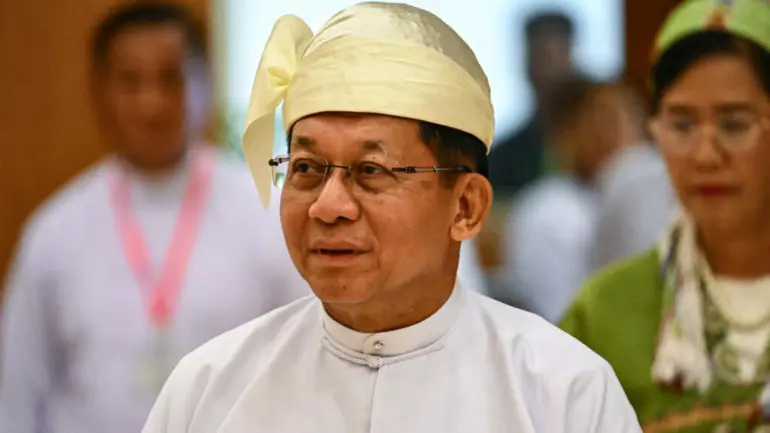
Min Aung Hlaing was sworn in as president on Friday, extending his grip on power five years after seizing control in a military coup.
As commander-in-chief of Myanmar’s armed forces, Min Aung Hlaing overthrew the elected government of Aung San Suu Kyi in 2021, detaining the Nobel Peace Prize laureate and plunging the country into a protracted civil war.
After ruling by decree for half a decade, he organised an election that concluded in January. The vote excluded Suu Kyi’s party and handed victory to military-aligned groups, paving the way for his transition into a civilian presidency.
“Myanmar has returned to the path of democracy and is heading toward a better future,” the 69-year-old said after taking the presidential oath at a parliamentary ceremony in the capital, Naypyidaw, marking the start of his five-year term.
Min Aung Hlaing formally stepped down as military chief ahead of assuming office, as the country prepares for the upcoming Thingyan New Year holiday.
Rebranding military rule
Democracy advocates have dismissed the transition as a cosmetic shift designed to repackage military rule under a civilian facade.
More than two-thirds of the 30 ministers sworn in alongside him are serving or former military officers. A similar proportion previously held roles in the post-coup junta, with more than ten facing international sanctions.
Security was tight in Naypyidaw ahead of the ceremony, with bomb squads deployed at hotels and multiple checkpoints surrounding parliament.
In the run-up to the inauguration, authorities released some political prisoners linked to Suu Kyi’s administration and invited back civil servants who had resigned in protest after the coup. Critics, however, described the moves as largely symbolic.
Min Aung Hlaing said his government would “grant appropriate amnesties to support social reconciliation, justice and peace,” but made no mention of Suu Kyi, who remains incommunicado and is serving a 27-year sentence widely condemned by rights groups as politically motivated.
According to the Assistance Association for Political Prisoners, more than 22,000 people have been detained since the coup, while thousands have died in the ongoing conflict.
‘Restore normal relations’
The military leadership has framed the election as a return to civilian rule and an opportunity for national reconciliation, though Myanmar’s rulers remain largely isolated internationally.
Analysts say the vote was also aimed at legitimising the regime and reviving foreign engagement, including stalled investment projects.

Min Aung Hlaing pledged to “work to restore normal relations” with the Association of Southeast Asian Nations, which has largely sidelined Myanmar since the coup.
Representatives from neighbouring countries including China, India, and Thailand attended the ceremony, alongside delegates from about 20 other nations.
Myanmar’s military has dominated the country’s politics for most of its post-independence history. A brief period of reform beginning in 2011 saw a partial shift toward civilian rule under Suu Kyi, before the military reclaimed power following her party’s landslide victory in the 2020 elections.
The junta-organised vote excluded major opposition parties and was not held in large parts of the country controlled by armed resistance groups, further undermining its credibility, according to election observers.
AFP