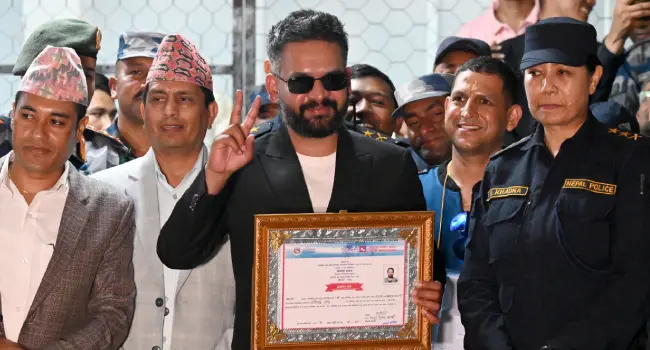
Nepal was close to completing the vote count from its parliamentary elections on Wednesday, with about two percent of ballots remaining, as rapper-turned-politician Balendra Shah’s centrist Rastriya Swatantra Party (RSP) secured a commanding lead.
Shah, 35, appears set to become the country’s next prime minister, marking a dramatic rise from his role as mayor of the capital, Kathmandu, and one of the most striking political upsets in recent Nepali history.
The March 5 election was the first national vote since youth-led anti-corruption protests last September that toppled the government following deadly unrest.
Shah also defeated veteran politician and four-time prime minister KP Sharma Oli in his own constituency. Oli’s Marxist-led government had been forced from power during last year’s protests.
The election drew widespread attention on social media, with videos circulating of voters mimicking Shah’s signature dance moves during campaign events.
Voters were electing a 275-member House of Representatives, the lower chamber of Nepal’s parliament. Of the seats, 165 are chosen through direct elections, while 110 are allocated through proportional representation.
Official results show the RSP dominating the direct contests, winning 125 of the 165 seats.
In the proportional representation vote, the party has also secured the largest share, nearly half of all ballots counted so far with just over 200,000 votes still to be tallied.
“We are close to finishing the counting now. We will have the final number of proportional representation seats soon,” Election Commission spokesman Narayan Prasad Bhattarai told AFP.
If the current trend holds, the RSP is projected to win around 176 seats, a landslide majority but still short of the 183 seats required for a supermajority.
The final allocation of seats may still shift slightly, as votes cast for smaller parties that fail to meet the threshold for representation are excluded from the proportional seat calculation.
Constitutional law expert Bipin Adhikari said it could take more than a week before Nepal formally appoints a new prime minister.
“Once the election commission submits its report to the president, he will invite RSP lawmakers to nominate their candidate for prime minister. Only after that will the appointment take place,” said Adhikari, a professor at Kathmandu University.
AFP