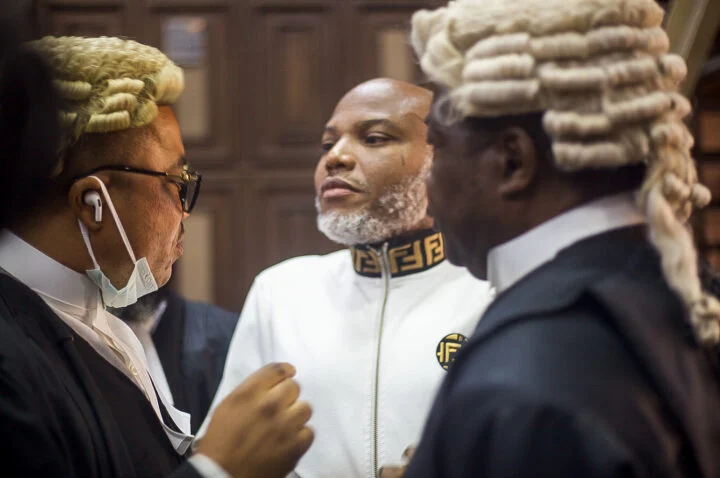
The detained leader of the Indigenous People of Biafra (IPOB), Nnamdi Kanu, has filed a notice of appeal challenging his conviction and multiple sentences handed down by the Federal High Court in Abuja, describing the trial as marred by fundamental legal errors and a miscarriage of justice.
In the notice of appeal, dated February 4, 2026, Kanu stated that he was appealing his conviction and sentences on seven counts, including terrorism-related offences, for which he received five life sentences and additional prison terms after being found guilty on November 20, 2025.
“I, Nnamdi Kanu, the Appellant, having been convicted and sentenced… do hereby give notice of appeal against my conviction,” the document read.
Kanu was convicted on offences including “committing an act preparatory to or in furtherance of an act of terrorism,” “making a broadcast… with intent to intimidate the population,” and “being the leader and member of the Indigenous People of Biafra (IPOB), a proscribed organisation in Nigeria,” among others.
Justice James Omotosho of the Federal High Court, Abuja, delivered the judgment on November 20, 2025, sentencing Kanu to five life terms for terrorism-related offences, 20 years’ imprisonment for leading a proscribed organisation, and five years’ imprisonment with no option of fine for importing a radio transmitter without a licence.
In his grounds of appeal, Kanu argued that the trial court failed to address what he described as a “foundational disruption of the original trial process” following the 2017 military operation at his Afara-Ukwu residence.
“The learned trial judge erred in law by failing to resolve the procedural and competence consequences of the foundational disruption of the original trial process in September 2017,” the appeal document stated.
He further claimed that the court proceeded with the trial and delivered judgment while his preliminary objection challenging the competence of the proceedings remained unresolved. “The learned trial judge did not hear or determine the objection,” the document added, noting that judgment was delivered “while the objection remained pending and undetermined.”
Kanu also faulted the court for delivering judgment while his bail application was still pending, arguing that this compromised the fairness of the trial process.
Additionally, he contended that he was convicted under a law that had been repealed, stating that “the learned trial judge erred in law by convicting and sentencing the Appellant under the Terrorism Prevention (Amendment) Act, 2013, notwithstanding its repeal by the Terrorism (Prevention and Prohibition) Act, 2022, prior to judgment.”

The IPOB leader further alleged double jeopardy, contrary to Section 36(9) of the 1999 Constitution, claiming he was retried on facts previously nullified by the Court of Appeal. He also asserted that he was denied a fair hearing, as he was not permitted to file or present a final written address before the judgment was delivered.
Among the reliefs sought, Kanu asked the Court of Appeal to allow his appeal, quash his convictions and sentences, and “discharge and acquit the Appellant in respect of all the counts.” He also requested to be present during the appeal hearing, stating, “I want to be present at the hearing of the appeal because I may be conducting the appeal in person.”
Kanu is currently being held at a correctional facility in Sokoto State, after his request for transfer to a different facility in either Niger or Nasarawa State was denied.