
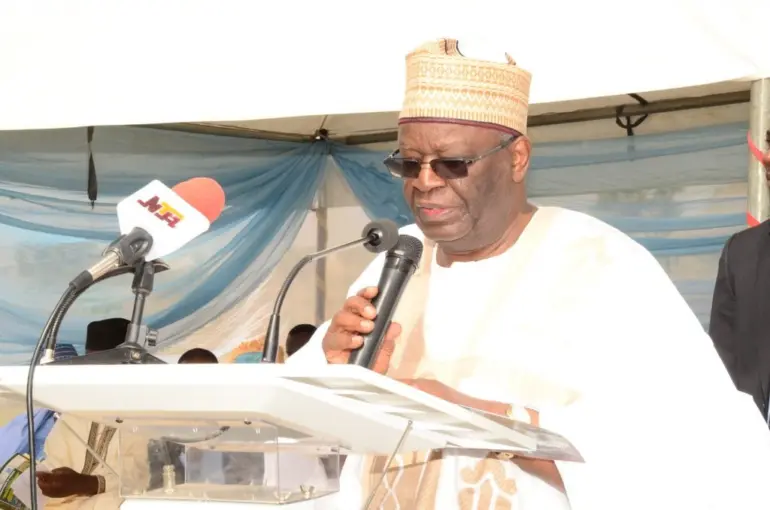
A former Chief of Staff to ex-President Muhammadu Buhari, Prof. Ibrahim Gambari, has said the late leader was deeply troubled by his inability to fully resolve Nigeria’s security challenges before leaving office.
Gambari made the remarks on Channels Television’s Politics Today on Monday, noting that while Buhari took some comfort in the gains recorded against Boko Haram, he remained concerned about persistent insecurity in other parts of the country.
“One of the things that pained him the most was that he was unable to do more about the security situation in the country before he left office,” Gambari said. “He did a lot by ensuring that no part of Nigeria remained under Boko Haram control.”
He explained, however, that the continued menace of banditry and violent attacks in the North-West and parts of the North-Central weighed heavily on the former president.
“The situation in the North-West and the North-Central, particularly banditry, pained him deeply. He felt he had done everything possible for the people, but at some point he even questioned whether the foundation was strong enough,” Gambari added.
Addressing reports of coup threats toward the end of Buhari’s administration, Gambari dismissed the claims, saying no such intelligence was brought to his attention during his tenure as Chief of Staff.
“Honestly, I am not aware of that. The president had multiple sources of information. The Chief of Staff is an important one, but not the only one. He may have received information that I was not privy to,” he said.
Gambari noted that Buhari, who governed Nigeria both as a military head of state and later as an elected president, maintained close relations with the armed forces but operated strictly within constitutional limits.

Reflecting on Buhari’s leadership style, he said the former president was deeply loyal to individuals who played significant roles in his personal and political journey, while observing that those who benefited most from the country were often the least committed to its stability.
On internal power dynamics, Gambari acknowledged that every administration has a “cabal,” but stressed that Buhari’s inner circle understood its boundaries. He also said the former president opposed imposing a successor in the 2023 general election, insisting that leadership choices should be determined by party members and voters.
Buhari served as Nigeria’s elected president from 2015 to 2023, having earlier ruled as military head of state between 1983 and 1985. He died on July 13, 2025, at the age of 82, after a prolonged illness.
