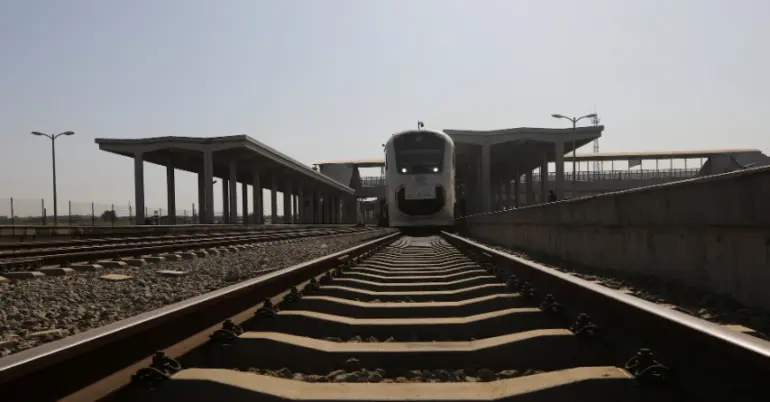
The Senate on Thursday launched a wide-ranging investigation into operational inefficiencies, insecurity and alleged financial improprieties plaguing Nigeria’s railway system, amid mounting concerns over declining service delivery across major rail corridors.
The decision followed a motion raised during plenary by Senator Abdul Ningi and a point of order by Senator Adamu Aliero, who drew the Senate’s attention to the deteriorating state of rail operations, particularly along the Abuja–Kaduna–Kano corridor.
Consequently, the President of the Senate, Senator Godswill Akpabio, inaugurated an ad hoc committee chaired by Senator Adams Oshiomhole to conduct a comprehensive probe of the railway system. Other members of the committee include Senators Enyinnaya Abaribe and Abdul Ningi, among others.
The committee is mandated to examine the execution of railway contracts, funding patterns, operational efficiency, service delivery, and the utilisation of loans secured for rail projects. It is expected to submit its report within six weeks.
The probe will focus significantly on the billions of dollars in foreign loans deployed for railway construction, the quality of infrastructure delivered, and whether value was obtained for the funds expended.
Although the ad hoc committee was initially constituted in November 2025, it has now been formally activated to undertake a more detailed and focused investigation.
Raising a point of order, Aliero lamented the sharp decline in train services, noting that routes which previously recorded up to 10 daily trips have been reduced to just one.
“I call the minister almost weekly and put pressure on him. I tell him, ‘This rail line is the pride of the nation. We cannot afford to let it collapse,’” Aliero said. “All efforts must be made to restore railway services from Abuja to Kaduna.”
Commenting on the matter, Akpabio expressed deep concern over the state of rail services nationwide, particularly the Abuja–Kaduna route, lamenting the drastic increase in travel time and declining efficiency.
He noted that the Abuja–Kaduna railway contract was awarded under former President Umaru Musa Yar’Adua, transmitted under President Goodluck Jonathan and commissioned during the administration of former President Muhammadu Buhari.
“In fact, it was completed under Buhari with a loan from China. But today, some of these trains are so slow that if you are walking, you may arrive faster,” Akpabio said. “On the Lagos line, even if you walk briskly, you will outrun the train. On the Ibadan route, a bicycle could get there before the train reaches halfway.”
Describing the situation as a “peculiar Nigerian problem,” Akpabio questioned the quality of execution of the rail projects, stressing that a properly delivered railway system should not require major repairs within its early years of operation.
“If the rail system was well executed, you would not need repairs for at least five to seven years, or even 10 years,” he said. “I also understand that in some cases the tracks are too small for the coaches. When they take a bend, there is a risk of derailment because old tracks from the 1960s and 1970s may have been used.”
The former Akwa Ibom State governor further faulted the procurement process and questioned whether warranty provisions were breached.
“We must examine the entire contract—funding, execution and warranties,” he said. “If the warranty period has not expired, the suppliers should repair the equipment at their own cost, not with Nigerian money. We are not even making efforts to recover losses or determine why second-hand coaches were supplied.”
Akpabio insisted that no responsible country would knowingly procure second-hand equipment for a modern rail system, adding that whatever went wrong was “man-made” and required accountability.
In his motion, Ningi alleged that the Abuja–Kaduna–Kano rail project was poorly executed despite generating substantial revenue. He claimed that the rail line had generated over ₦1.8 billion without any corresponding improvement in service delivery.
According to him, travel time on the Abuja–Kaduna route, which initially averaged about one and a half hours, has increased to approximately three and a half hours. He also disclosed that daily operations have been reduced to a single trip, a 7:00 a.m. departure from Abuja with a return journey from Kaduna, down from multiple daily services.
“I don’t want this matter to be misconstrued,” Ningi said. “I asked whether the cargo coaches were new when purchased, and the answer was no, they were second-hand. At least ₦1.7 billion has been generated. Where is the money? People paid for these services.”
Responding, Akpabio reaffirmed the Senate’s constitutional oversight role, stressing that the probe was aimed at accountability and corrective action.
“We are a corrective parliament. Our duty under the Constitution is to ask questions, identify what went wrong and correct it,” he said. “If people kept public funds meant for new coaches and used them to buy second-hand ones, they must be made to return the money.”
He added that recovered funds could be used to repair or fully refurbish the rail coaches.
Addressing the committee chairman directly, Akpabio charged Oshiomhole to conduct a thorough and uncompromising investigation.
“Look at the tracks, the coaches—everything. Why should a journey that ought not to exceed 25 minutes now take three and a half hours?” he asked. “By modern railway standards, this is unacceptable. Even a tricycle could reach Kaduna and return to Abuja before the train. You must do your work.”