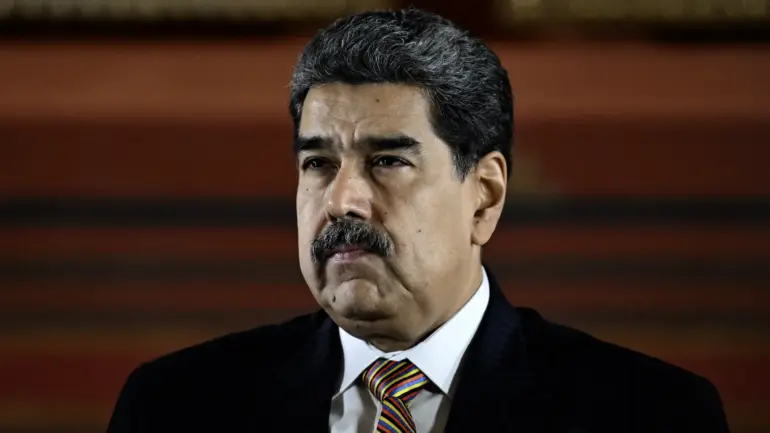
Deposed Venezuelan President Nicolas Maduro pleaded not guilty to charges of narco-terrorism in a New York federal court on Monday, two days after US forces conducted a dramatic raid on his Caracas residence.
Maduro, 63, told a Manhattan judge that he had been “kidnapped” from Venezuela, insisting, “I’m innocent; I’m not guilty. I’m still the president of my country,” according to US media reports. His wife, Cilia Flores, also pleaded not guilty.
The pair were seized in the early hours of Saturday by US commandos, supported by warplanes and a heavy naval presence. The raid sparked global alarm, as President Donald Trump declared over the weekend that the United States was now effectively in control of Venezuela, with plans to rebuild and manage its vast, though degraded, oil industry.
The operation drew sharp international criticism. UN Secretary-General António Guterres, speaking at an emergency UN Security Council session, emphasized respect for “sovereignty, political independence, and territorial integrity.”
In Latin America, Mexico’s President Claudia Sheinbaum condemned the raid, saying the Americas “do not belong to anyone,” while Colombian President Gustavo Petro, a former guerrilla fighter, warned he was prepared to “take up arms” against US actions.
Maduro, who took office in 2013 after the death of Hugo Chávez, has long been accused by the United States and the European Union of rigging elections, suppressing opponents, and overseeing widespread corruption. His ouster ends a quarter-century of leftist rule, leaving Venezuela’s 30 million citizens facing deep uncertainty.
Thousands of Maduro supporters rallied in Caracas over the weekend, some armed, waving Venezuelan flags. In parliament on Monday, deputies shouted “Let’s go, Nico!” in support of the ousted leader.
Meanwhile, interim president Delcy Rodriguez, formerly Maduro’s vice president, shifted from an initially defiant stance, signaling readiness for “cooperation” with the US. The Trump administration has indicated it seeks continuity with Maduro’s remaining associates, provided they comply with American demands, rather than restoring opposition figures previously denied power.
Access to oil
When asked what he expects from Rodriguez, Trump stated: “We need total access. We need access to the oil and other resources in their country that allow us to rebuild their country.”
Venezuela has the world’s largest proven oil reserves, but years of sanctions and mismanagement have left the infrastructure fragile. The announcement drove shares in US oil majors including Chevron, ExxonMobil, and ConocoPhillips—higher on Wall Street.
Trump’s extraordinary moves in Venezuela reflect his increasingly assertive foreign policy. Over the weekend, he also claimed Cuba was “ready to fall” and suggested Greenland should come under US control. He directly warned Colombia’s Petro, saying he should “watch his ass.”

While no US troops are currently reported inside Venezuela, the administration maintains leverage through an oil blockade, and additional military action has been threatened. A large US naval deployment, including an aircraft carrier, remains positioned in the Caribbean.
Emerging reports from Caracas indicate that 32 Cubans were killed during the US operation. US officials said no American service members were killed, though some were wounded.
The case drew protest and support on the streets of New York. Sydney Loving, a 31-year-old leftist activist, told AFP: “We say no to US wars. We say no to US intervention. It does not make the US safer; it makes Wall Street richer.”
Conversely, Angel Montero, a Venezuelan expatriate, called Maduro’s removal “the best gift I ever received,” adding, “I’m going to thank Donald Trump.”
AFP