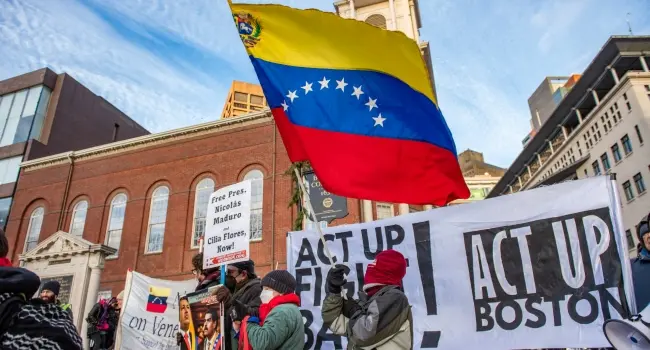
World leaders have continued to react to the United States’ military operation in Venezuela and the arrest of the country’s president, Nicolas Maduro, with responses ranging from condemnation to cautious support.
Reactions from capitals across the globe revealed deep divisions over the legality and implications of the US action.
United Nations
The United Nations Security Council will convene an emergency meeting on Monday to discuss the US operation in Caracas, the Somali presidency of the Council told AFP on Saturday.
The meeting, scheduled for 10:00 a.m. (1500 GMT), was requested by Venezuela and relayed by Colombia, according to diplomatic sources.
Russia
Russia urged the United States to immediately release President Maduro and his wife following their capture by US forces.
“We strongly urge the American leadership to reconsider its position and release the legally elected president of a sovereign country and his wife,” the Russian foreign ministry said in a statement.
Italy
Italian Prime Minister Giorgia Meloni defended the US military action, describing it as a legitimate act of defence, while cautioning against the use of external force to impose regime change.
“The government believes that external military action is not the solution to ending totalitarian regimes,” Meloni said, adding that defensive intervention could be justified in response to “hybrid attacks” linked to drug trafficking. Meloni is a close ally of US President Donald Trump.
France
France condemned the US operation, warning that it undermined international law and that Venezuela’s political crisis could not be resolved through external force.
While noting that Maduro had “gravely violated” the rights of Venezuelans, Foreign Minister Jean-Noël Barrot said the operation “contravenes the principle of non-use of force, which underpins international law.”
“No lasting political solution can be imposed from the outside,” he said, warning that growing violations of international law by permanent UN Security Council members could have serious global security consequences.
Turkey
Turkey called on all parties to exercise restraint, warning that the situation could have negative implications for regional and international security.
“In order to prevent the current situation from leading to negative consequences for regional and international security, we call on all parties to act with restraint,” the Turkish foreign ministry said.
Brazil
Brazilian President Luiz Inácio Lula da Silva sharply criticised the US action, describing the strikes and Maduro’s capture as a “serious affront” to Venezuela’s sovereignty.
“The bombings on Venezuelan territory and the capture of its president cross an unacceptable line,” Lula wrote on X, warning that the actions threatened “the preservation of the region as a zone of peace.”
He urged the international community, through the United Nations, to respond “vigorously” to the situation.
China
China condemned the US military operation, calling it a violation of international law and Venezuela’s sovereignty.
“China is deeply shocked and strongly condemns the US’s blatant use of force against a sovereign state and its action against its president,” the foreign ministry said, adding that the move threatened peace and security in Latin America and the Caribbean.
United Kingdom
British Prime Minister Keir Starmer urged all countries to uphold international law, stressing that the UK had no involvement in the US operation.
Describing the situation as “fast-moving,” Starmer said he would consult with allies, including President Trump, and called for patience while facts were established.
“I can be absolutely clear that we were not involved in that,” he said in televised remarks. “We should all uphold international law.”
Germany
German Chancellor Friedrich Merz said Maduro had “led his country to ruin,” noting that Germany did not recognise Venezuela’s last election, which it considers rigged.
However, Merz said the legal implications of the US action were “complex” and stressed that “the principles of international law must apply in relations between states.”
“Political instability must not be allowed to arise in Venezuela now,” he added.