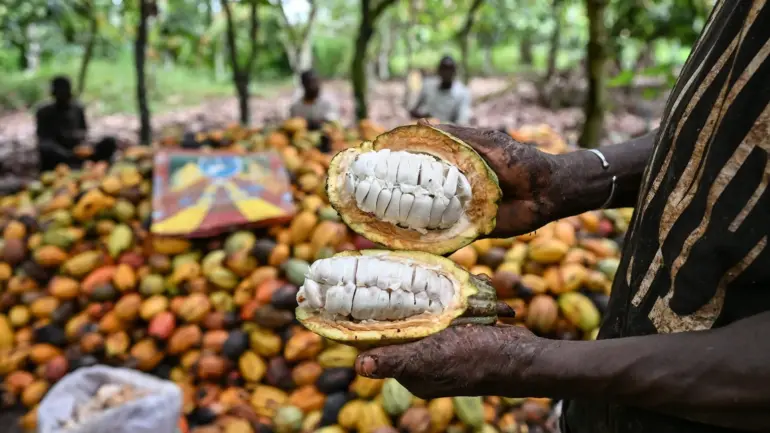
After nearly two years of soaring prices, cocoa has tumbled sharply in 2025. Yet chocolate, in high demand ahead of the festive season, continues to command elevated prices. AFP examines the reasons behind this divergence and the current state of the cocoa market.
Ivory Coast and Ghana are the world’s largest suppliers of cocoa pods, the fruit of the cacao tree from which cocoa beans are extracted to make chocolate. Together, they account for over half of global production, with Brazil, Cameroon, Ecuador, Indonesia, and Nigeria supplying most of the remainder.
The concentration of plantations in West Africa makes the cocoa market highly vulnerable to regional weather patterns and tree diseases. Cultivation is predominantly carried out by thousands of independent smallholders.
Record-high prices in 2024
Between 2021 and 2024, cocoa harvests repeatedly failed to meet rising demand, driving prices to unprecedented levels.
“That was the result of … supply-side issues like ageing trees, the spread of swollen shoot virus, and black pod disease in Ghana and Ivory Coast,” Rabobank analyst Oran van Dort told AFP. Low usage of fertiliser and pesticides, due to farmers’ limited incomes, further exacerbated the problem.
In December 2024, cocoa prices peaked at $12,000 per tonne in New York, compared with $1,000–$4,000 per tonne for most of the 1980s.
In Ghana and Ivory Coast, governments set cocoa prices. Higher guaranteed prices have empowered producers to invest in fertiliser, machinery, and new trees, boosting harvests.
“For the first time in years, I feel like we are farming with the government behind us, not on our own,” said Ghanaian producer Kwame Adu, 52.
“Last year went well because as the cocoa was set to bear fruit, the rains came,” added Jean Kouassi, a 50-year-old Ivorian farmer with four hectares of plantations, roughly six football pitches in size.
Less cocoa in products, but chocolate stays expensive
High raw material costs have forced chocolate manufacturers to make tough choices: shrinkflation, price hikes, and reducing cocoa content. Saxo Bank analyst Ole Hansen noted, “Record-high raw material costs have forced chocolate makers into a series of unpopular choices: shrinkflation, price increases, and the quiet dilution of cocoa content.”
UK snack brand McVitie’s recently disclosed that Penguin and Club bars no longer qualify as chocolate, having reduced their cocoa content. Instead, they are now labeled “chocolate flavour,” a major reversal for Club, which once advertised: “If you like a lot of chocolate on your biscuit, join our club.”

Meanwhile, global chocolate giants Ferrero, Mars, Mondelez, and Nestlé have seen demand soften after raising prices. Despite the cocoa price slump, New York prices are now around $6,000 per tonne, chocolate costs remain high.
“The current slump arrives far too late to affect Christmas assortments already produced and priced months ago,” Hansen said. Nestlé told AFP that it is “still too early to comment on specific changes regarding prices” and cautioned that the market remains volatile.
There is hope for Easter products like eggs and chocolate bunnies, but only if cocoa prices stabilize around current levels, Hansen added.
AFP