

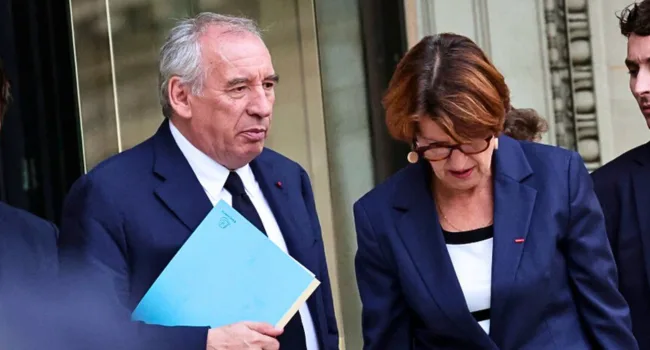
French Prime Minister François Bayrou tendered his resignation to President Emmanuel Macron on Tuesday, a day after suffering a crushing defeat in a confidence vote in parliament. The vote, called by Bayrou himself, ended in a resounding rejection of his government, deepening an already simmering political crisis.
Bayrou’s exit leaves Macron scrambling to appoint the seventh prime minister of his presidency—his sixth since 2022—amid rising domestic tensions and market unease.
In a statement, the Élysée Palace confirmed that Macron had “taken note” of the government’s collapse and would appoint a new premier “in the coming days,” dismissing speculation that he might instead dissolve parliament and call snap elections.
Bayrou was seen arriving at the Élysée Palace on Tuesday afternoon and left just over an hour later. A source close to him confirmed he had formally submitted his resignation. He will continue to serve in a caretaker capacity until a successor is named.
Macron has previously been slow to appoint new heads of government, but with markets jittery and the political atmosphere volatile, analysts expect a swift decision this time.
“Emmanuel Macron is now in the front line to find a solution to the political crisis,” Libération reported.
Investor concerns were reflected in France’s rising borrowing costs, which on Tuesday briefly climbed above those of Italy—long seen as one of Europe’s more financially fragile economies. The development underscores growing unease about France’s political stability and fiscal direction.
‘Vulnerable president’
Bayrou had stunned even his own allies by calling the confidence vote, seeking to end a prolonged impasse over his controversial austerity budget. The proposed plan aimed to cut nearly €44 billion ($52 billion) in public spending to rein in France’s ballooning debt.
But the gamble backfired. Of the 577-member National Assembly, 364 deputies voted no confidence in his government, while only 194 expressed support.
“Emmanuel Macron, a vulnerable president,” Le Monde declared, reflecting growing concern over his shrinking authority.
Bayrou had replaced Michel Barnier, who himself was toppled by a no-confidence vote in December. Both premiers struggled to navigate a gridlocked parliament, the result of the inconclusive 2024 legislative elections that left no party with a clear majority.
Key decision looms for Macron
Now, Macron faces one of the most critical domestic choices of his presidency: who to name as prime minister to restore stability and govern effectively.
The Socialist Party (PS) has expressed willingness to lead a new government, with PS leader Olivier Faure floated as a potential premier. However, questions remain over whether such a government could survive a confidence vote in the fractured National Assembly.
Should Macron opt for continuity, Defence Minister Sébastien Lecornu is seen as a leading contender. A close ally of the president, Lecornu has served throughout Russia’s war on Ukraine and is regarded as a pragmatic and loyal operator with no known presidential ambitions—qualities that may appeal to Macron at this juncture.
Other potential candidates who might attract broader consensus include Health Minister Catherine Vautrin, Finance Minister Éric Lombard, and Parliament Speaker Yaël Braun-Pivet.

Tensions on the streets
As the political elite negotiates behind closed doors, public discontent is spilling onto the streets. A leftist coalition known as “Block Everything” has called for a day of protest on Wednesday, while major trade unions have scheduled a nationwide strike for September 18.
“We need a new prime minister very quickly,” warned Interior Minister Bruno Retailleau, who also leads the conservative party Les Républicains. He stressed that the government must avoid a “power vacuum” in the face of looming social unrest.
2027 Election on the Horizon
Looking ahead, the 2027 presidential race remains wide open. Macron, constitutionally barred from seeking a third term, will not run. Analysts suggest the political chaos could strengthen the far-right National Rally (RN), led by Marine Le Pen.
Le Pen’s presidential hopes, however, hinge on the outcome of an appeal next year concerning her conviction in a fake jobs scandal involving European Parliament funds, which currently disqualifies her from standing for office.
RN President Jordan Bardella told broadcaster RTL on Tuesday that his party would move to topple any new government that fails to “break with the politics of the last eight years.” He reiterated calls for early legislative elections.
