

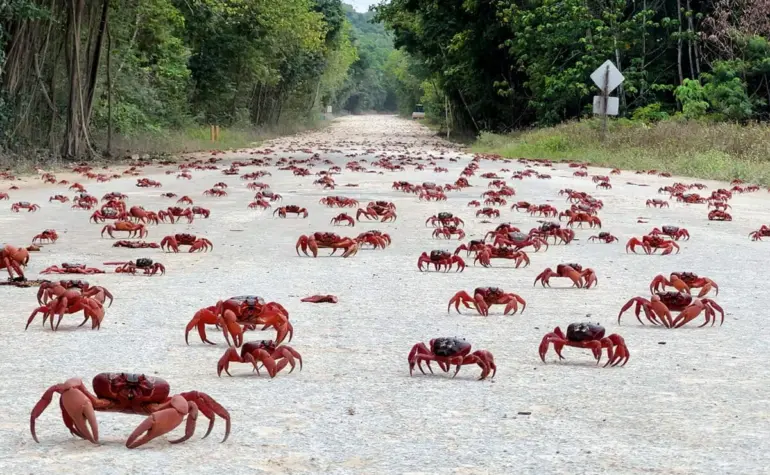
More than 100 million red crabs have begun their annual migration from the forests to the coast of Australia’s Christmas Island, marking one of the world’s most remarkable wildlife spectacles, conservationists have said.
The annual migration, which coincides with the onset of the rainy season, sees millions of the crustaceans move towards the sea to breed.
The timing of the mass movement across forests, roads and bridges is closely linked to lunar cycles, with the crabs expected to spawn “before dawn on a receding high tide during the moon’s last quarter”, according to Parks Australia.
The spectacular migration requires months of preparation by conservationists on Christmas Island, a remote Australian territory in the Indian Ocean located about 350 kilometres (217 miles) south of Indonesia and more than 1,000 kilometres from mainland Australia.
“People travel from around the world to witness this incredible wildlife spectacle on Christmas Island,” said Chris Chartres, manager of Christmas Island National Park under Parks Australia.
Chartres attributed the recovery of the red crab population to sustained conservation efforts, particularly measures to control yellow crazy ants, which have been identified as one of the species’ biggest threats.
The invasive ants, named after their erratic movements when disturbed, had displaced tens of millions of red crabs by taking over their burrows.
However, conservation efforts to control the ant population have helped red crab numbers recover from an estimated 50 million to more than 100 million, according to conservationists.
“That’s a great sign the population is thriving,” Chartres said.

He described red crabs as a keystone species on the island, highlighting their importance in maintaining the health of its forest ecosystem.
“Red crabs are the island’s keystone species. They play a critical role in maintaining the health of the forest, so when the crabs are doing well, the whole ecosystem benefits,” he added.
Christmas Island covers an area of just 135 square kilometres, making the annual migration of its millions of red crabs an extraordinary natural event and a major attraction for visitors from around the world.