

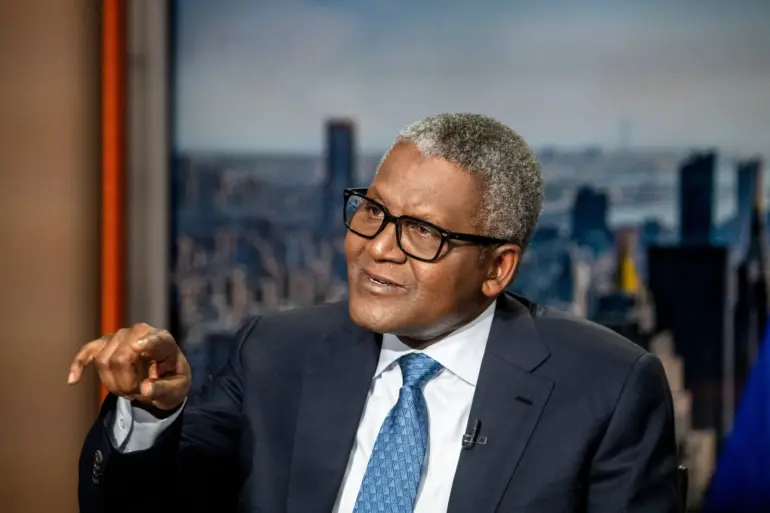
Founder and President/Chief Executive of Dangote Industries Limited, Aliko Dangote, has revealed that his company paid interest rates of up to 40 per cent to Nigerian banks while financing the construction of its Obajana Cement plant in Kogi State.
Dangote said the project, initially estimated to cost $180m, encountered significant delays and cost overruns due to inadequate infrastructure and other operational challenges, eventually pushing its total cost to $1bn.
He disclosed this on Thursday at the 25th annual conference of Women in Management and Business in Lagos, where he urged women entrepreneurs to venture into industrial businesses and pursue ambitious investment plans.
Recounting the financial challenges involved in developing the Obajana plant, now Dangote Cement’s flagship facility, he said the company secured loans from local banks at a time when their capital base was about ₦25bn.
“You won’t believe how much interest we were paying when we built Obajana (Kogi State, Nigeria). I tell you, we were able to do it when the banks were at ₦25bn capital. And we took on a project of $180m,” Dangote said.
He explained that the company initially did not invest in critical infrastructure such as gas pipelines, fuel facilities and power plants because it expected the government to provide adequate public utilities.
“So we ended up having a problem. We didn’t put in a gas pipeline, we didn’t put fuel in, we didn’t put in a power plant. All these things, because the government announced that we’d be having enough power, we’d be having enough this and that,” he said.
According to him, the infrastructure deficiencies contributed to the escalation of the project’s cost to $1bn, forcing the company to seek additional financing from the International Finance Corporation.
Dangote said the IFC rejected the company’s proposed three-year repayment plan after reviewing its financial projections and instead offered a seven-year arrangement, including an initial two-year grace period.
“We wanted to pay within three years, but when the IFC used their own financial model, they said our business plan was wrong. They gave us seven years. They said in the first two years we cannot pay anything. Then, in five years, is the payment period,” he said.
Despite the extended repayment arrangement, Dangote said borrowing from Nigerian banks remained expensive, with interest rates reaching 40 per cent.
“But because our interest rates were high, we were paying combined. Also, I don’t want to mention the name. But we were paying interest at 40 per cent to the local banks. They can check the records,” he said.
He recounted how he eventually invited the bankers to dinner six months before the expiration of the 18-month financing arrangement and settled the outstanding loans.
“On the 18th month, six months before the expiry, I invited the bankers to dinner, and at the end of the dinner, I gave everybody their cheque. I paid off,” he said.
Obajana is Dangote Cement’s largest factory in Nigeria, with an installed production capacity of 16.25 million tonnes per annum across five production lines.
The plant was commissioned in 2007 with two production lines and a combined capacity of five million tonnes per annum.
Its capacity increased to 10.25 million tonnes per annum in 2012 following the addition of a third production line. Two additional lines, each with a capacity of three million tonnes per annum, were subsequently commissioned in late 2014 and 2020.
Dangote also recounted the challenges involved in developing the Dangote Petroleum Refinery, saying international engineering companies and other industry players initially doubted the feasibility of the project.
He said the company initially planned to build a refinery with a capacity of 300,000 barrels per day but later increased the target to 650,000 barrels per day, despite warnings about the scale and complexity of the undertaking.
According to him, some international engineering, procurement and construction contractors declined to participate in the project because they considered Nigeria too risky.
He said the company eventually assumed the role of its own engineering, procurement and construction contractor and completed a refinery whose capacity has since exceeded its original design.
“We’re able not only to deliver the 650,000, which they say will not be done. We now are at 710,000 barrels,” he said.
The industrialist urged women entrepreneurs to think ambitiously, set clear business targets and take calculated risks in pursuing their goals.
“Don’t let anybody tell you that you are not able to do it. You must think very, very big. You must be very ambitious. You must give yourself a target and believe that you can deliver that target,” he said.

He also identified inadequate infrastructure as a major obstacle to business growth in Nigeria, noting that some companies had been forced to invest in facilities that should ordinarily be provided through public infrastructure.
“We are facing a lot of issues in terms of infrastructure. And right now, sometimes, what we do is we put the money down. I would like to build this infrastructure, and then we just do it on our own,” he said.
Dangote further urged business leaders to remain resilient in the face of setbacks, stressing that entrepreneurship and industrial investments often come with considerable challenges.
“There is nothing in life that is easy. So you must say that yes, it’s difficult for me, but I can surmount all these pressures,” he said.
He also disclosed that the Dangote Petroleum Refinery was expected to achieve the highest profitability on the African continent within 55 days, describing profitability as the company’s immediate priority.
Earlier, the Founding Chairperson and Trustee of Women in Management and Business, Omobola Johnson, reflected on the organisation’s 25-year history and its efforts to build a sustainable platform for women in business and management.
Johnson said the founders had sustained their commitment through inclusion, mutual respect, shared leadership and effective succession planning.
She noted that WIMBIZ had also challenged the perception that women could not work together, pointing to the organisation’s continued growth and longevity.
“We countered the fallacy that women cannot work together. We have worked together for 25 years, and we have built an institution that has endured, stood the test of time,” Johnson said.
She added that the founders had placed their collective vision above personal interests and ethnic differences while promoting diversity, collaboration and a shared sense of purpose.