
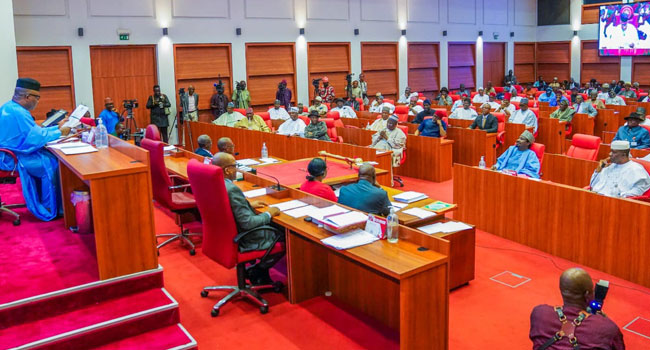
The Senate on Tuesday stepped down the Agricultural Revolution Bill, 2026, sponsored by Deputy Senate President Barau Jibrin, following objections from lawmakers over its drafting, scope and the failure to provide printed copies to senators.
The bill, SB. 1082, seeks to establish a legal framework for transforming and modernising Nigeria’s agricultural sector.
The decision followed a heated debate during its second reading, with some lawmakers questioning the quality of the proposed legislation and whether the Senate’s rules on the circulation of bills had been followed.
The second-reading motion was moved by the Senate Leader, Mohammed Monguno, on behalf of Barau.
Presenting the bill, Monguno described it as a necessary intervention to tackle food insecurity, low agricultural productivity and structural challenges confronting the sector.
He noted that although agriculture provides livelihoods for millions of Nigerians, the sector continues to struggle with inadequate mechanisation, poor irrigation infrastructure, insecurity, limited access to affordable financing and high post-harvest losses.
“These challenges have resulted in food insecurity, inflation and increased poverty in the country. There is urgent need to move from piecemeal interventions to a coordinated, sustainable legal framework for agricultural transformation,” Monguno said.
He explained that the proposed legislation seeks to transition Nigeria from subsistence farming to modern, technology-driven and commercially viable agriculture through mechanisation, improved seeds, research, extension services, irrigation and agro-industrial development.
The bill also proposes improvements in storage facilities, cold-chain infrastructure, agro-processing and market access for agricultural products.
Seconding the motion, Senator Muhammad Aliero, representing Kebbi Central, supported the proposal, describing agriculture as a critical sector for economic diversification.
However, Senator Abdul Ningi, representing Bauchi Central, questioned the quality and legislative framework of the bill, despite describing its objectives as “excellent, fantastic and timeous”.
Ningi argued that the proposal appeared more like a motion than a properly developed piece of legislation, urging its sponsors to undertake further work before seeking its consideration.
He said Nigerian farmers produced between two and three tonnes per hectare, compared with eight to 10 tonnes in some other countries, stressing the need for improved mechanisation, research and farming practices to bridge the productivity gap.
While commending the Federal Government’s agreement to import agricultural machinery from Brazil, he questioned whether the bill adequately addressed the institutions already responsible for agricultural development.
“When you bring a bill that has agencies already in place to take care of irrigation and agricultural production, what you ought to do is first bring the bill; let’s see the bill, not something that looks like a motion,” he said.
“This bill did not say it is creating an agency; this bill did not say it is amending existing agencies. You are actually building something on nothing.”
Ningi urged the Senate to step down the proposal to allow its sponsors to strengthen its provisions.
“This is a brilliant idea, but a lot of work has not been done. If it is a motion, Mr President, this could be a very good motion, excellent preparatory work towards enacting a law. I believe we can stand down this bill and do a better job,” he added.
The debate became more contentious when a senator raised a point of order under Order 79(1) of the Senate Standing Orders, arguing that discussions at the second-reading stage should focus on the general principles of a bill rather than its detailed provisions.
However, several lawmakers protested that they had not received printed copies of the proposed legislation, triggering a rowdy session.
“Where is the bill? Show me a copy! Show me a copy!” some senators shouted.
The Senate President, Godswill Akpabio, who presided over the plenary, intervened and directed Barau to ensure that printed copies were distributed to all lawmakers.
“Deputy Senate President, please provide copies to all senators. Forget this platform. If the platform has collapsed, how will they see it?” Akpabio ruled.
In response, Monguno said the bill had been gazetted, uploaded to the Senate’s digital platform and circulated to senators’ offices.
He maintained that the digital platform formed part of the Senate’s agreed legislative process and that lawmakers were expected to familiarise themselves with proposed legislation before plenary consideration.
Further criticism came from Senator Yahaya Abdullahi, representing Kebbi North, a professor of agricultural economics and former head of department in the discipline.
Abdullahi questioned the attempt to regulate the entire agricultural sector through a single, broad piece of legislation, arguing that its various components required separate and targeted laws.
“Agriculture is too wide and omnibus a human endeavour for it to be covered effectively and efficiently under a single bill,” he said.
He maintained that issues such as agricultural subsidies, mechanisation and irrigation required specific legislative interventions rather than an all-encompassing legal framework.
Warning against the passage of poorly drafted legislation, Abdullahi said: “Laws are made to guide policy and implementation of programmes; they are not just nebulous presentations. Once you go there and make a law, of course it will be a law, but if it’s a bad law, it will stay like that forever.”

He urged lawmakers to identify specific challenges within the agricultural sector that required legislative intervention and address them individually.
“If we are serious about developing agriculture, let us look into the content of our agriculture and identify those areas of constraints where legislation is required and address those particular areas,” he said.
Defending the proposal, Monguno maintained that the second-reading stage was intended to examine the general principles of a bill, while detailed scrutiny would take place at subsequent legislative stages.
He also defended the use of the Senate’s digital platform but acknowledged that the necessary procedures could be completed before the bill was reintroduced.
The disagreement deepened when another senator accused the Senate Leader of attempting to intimidate colleagues by invoking his leadership position, insisting that all lawmakers were entitled to express their views freely.
The matter was eventually addressed after a ranking senator cited Section 3 of the Senate Rules, which provides that a printed copy of a bill should, as soon as possible, be sent to every senator.
The senator argued that the provision expressly required printed copies and did not recognise the digital platform as a substitute.
Faced with the objections, Barau withdrew the bill and promised to comply with the Senate’s rules.
“So it has been withdrawn until it is given to him. Since that’s what you want, I will get it done. Forget about the fact that it has been placed on the platform. As we agreed, we are going to give you and give others who have not gotten it. We will comply with the rules,” Barau said.
He added, “I am the Deputy Senate President. I will always want to please anyone to the best of my ability.”
Akpabio subsequently acknowledged the withdrawal and confirmed that the bill had been stepped down.
The proposed legislation could return to the Senate after the necessary procedures, including the distribution of printed copies to lawmakers, have been completed.
The development underscores the importance of legislative drafting and parliamentary procedure as the National Assembly considers measures to tackle food insecurity, boost agricultural productivity and modernise Nigeria’s farming sector.