

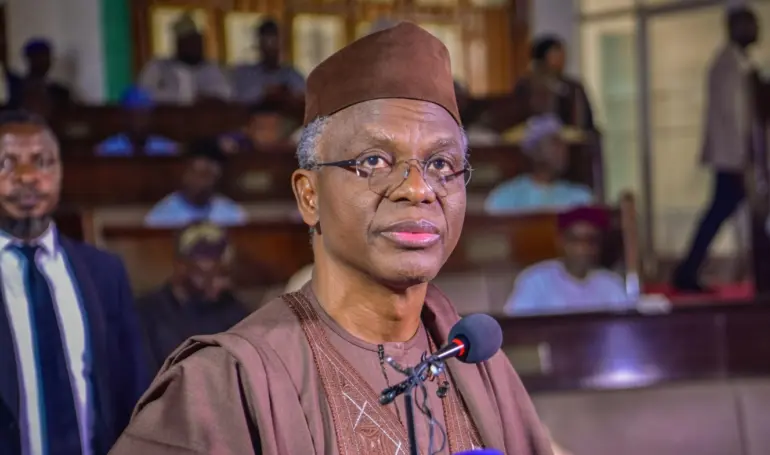
The Court of Appeal in Kaduna has dismissed an appeal by former Kaduna State Governor, Nasir El-Rufai, challenging the refusal of his fresh bail application by the Kaduna State High Court.
The three-member appellate panel, in a unanimous judgment delivered on Thursday, held that El-Rufai failed to present fresh facts or special circumstances sufficient to justify overturning the lower court’s decision.
The lead judgment, delivered by Justice Onyekachi Aja Otisi, affirmed the ruling of the Kaduna State High Court, which rejected the former governor’s second bail application on June 10, 2026.
A Certified True Copy of the judgment was obtained by our correspondent on Friday.
El-Rufai, who governed Kaduna State from 2015 to 2023, is being prosecuted by the Independent Corrupt Practices and Other Related Offences Commission (ICPC) over alleged financial offences linked to his administration.
The former governor has denied wrongdoing and challenged the circumstances surrounding his continued detention.
Following the High Court’s refusal to grant bail and its order for an accelerated hearing of the case, El-Rufai approached the Court of Appeal, seeking to overturn the decision.
However, the appellate court held that the trial court had exercised its discretion appropriately, based on the affidavit evidence presented by both the prosecution and the defence.
Otisi declared, “There is no merit in this Appeal. It fails and is hereby dismissed. The ruling of the lower Court delivered on 10/6/2026 is hereby affirmed.”
In its judgment, the appellate court considered the prosecution’s argument that some of El-Rufai’s public remarks, including statements made during a televised interview, raised concerns about possible interference with the administration of justice.
The prosecution had alleged that the former governor made remarks about defending his political legacy against those seeking to criminalise him.
It also alleged that, during an interview with Arise Television on April 26, 2026, El-Rufai admitted to wiretapping the telephone line of the National Security Adviser.
According to the judgment, El-Rufai acknowledged participating in the interview and being tried in a separate case relating to the subject matter.
However, the appellate court emphasised that its decision on bail did not amount to a determination of the allegations against him, stressing that he remained presumed innocent until proven guilty.
Otisi stated, “Now, without doubt, by unequivocal constitutional provisions, the Appellant is presumed innocent until proven guilty.”
He added that the trial court’s assessment of affidavit evidence concerning the possibility of interference with justice should not be interpreted as a finding of guilt.
The appellate court also considered El-Rufai’s argument that his return to custody after attending his late mother’s burial demonstrated that he was not a flight risk and should therefore be granted bail.
The former governor had maintained that his release to attend the burial and subsequent return to custody constituted compelling grounds for reconsidering his bail application.
The prosecution, however, argued that El-Rufai had been accompanied and closely monitored by security agents throughout the burial arrangements.
The court further noted that photographs allegedly showing the former governor attending funeral prayers at the National Mosque in Abuja were referenced in his affidavit but were not attached to the application before the trial court.
Otisi held that the trial judge could not speculate about the contents of documents that had not been presented as evidence.

“Courts are not allowed to act on speculations or conjecture to reach its decision, more so in our criminal jurisprudence,” he said.
The appellate court consequently upheld the lower court’s conclusion that El-Rufai had not established that his return to custody was entirely voluntary or that the circumstances surrounding the burial justified a different bail decision.
The Court of Appeal also upheld the order directing an accelerated hearing of the criminal case, with proceedings to be conducted from day to day as far as practicable while El-Rufai remained in ICPC custody.
The appellate panel noted that no evidence had been presented to demonstrate that the prosecution had failed to pursue the case diligently.
Otisi, however, indicated that the former governor could return to the trial court to seek further consideration of his bail application if the prosecution failed to prosecute the case diligently.
In a concurring opinion, Justice Abimbola Obaseki-Adejumo agreed that El-Rufai had not presented fresh and compelling facts to warrant a different decision.
She said, “Nothing had changed; therefore, I am unable to agree that a miscarriage of justice had occurred.”
Justice Lateef Ganiyu also concurred with the lead judgment, holding that the failure to attach documents relied upon in the bail application weakened the appellant’s case.
The ruling leaves the Kaduna State High Court’s decision to deny El-Rufai bail in place, while the criminal proceedings against the former governor continue.
