

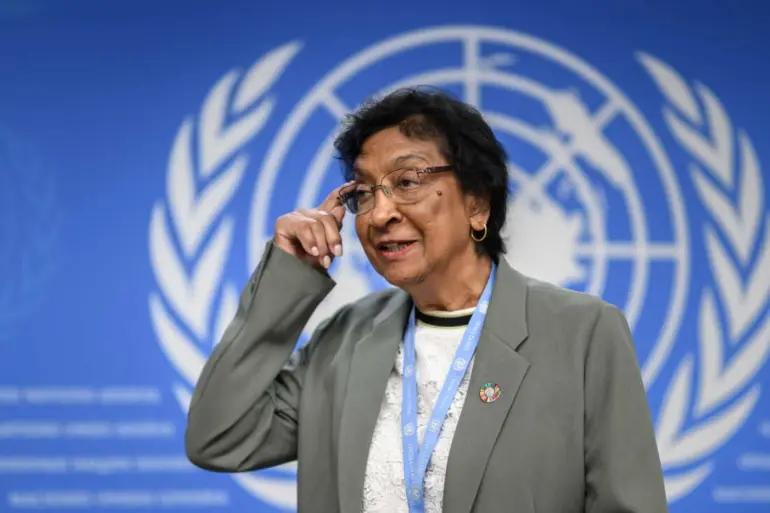
South African jurist Navanethem “Navi” Pillay has been awarded the 2026 Nobel Peace Prize for her longstanding efforts to promote peace, uphold international law and ensure accountability for war crimes, crimes against humanity and genocide.
The Norwegian Nobel Committee announced the award on Friday, October 9, 2026, recognising Pillay’s contributions to strengthening international justice and advancing universal legal principles.
In its announcement, the committee praised her unwavering commitment to justice, highlighting her courage, professional integrity and dedication to building a stronger international legal order.
“Navi Pillay’s commitment to universal legal principles and her firm moral compass are constants in a long career,” the committee said.
Born in Durban, South Africa, into a family of Indian Tamil origin during the apartheid era, Pillay built a distinguished legal career challenging racial discrimination and defending human rights. Her work has spanned national courts, international criminal tribunals and the United Nations, establishing her as a prominent figure in international law.
Pillay’s legal career began in South Africa, where she confronted the racial discrimination and exclusion entrenched under apartheid. Her work included defending anti-apartheid activists, including Nelson Mandela and others who opposed the system.
She subsequently served as a judge on South Africa’s High Court, the International Criminal Tribunal for Rwanda and the International Criminal Court (ICC).
Pillay also served as the United Nations High Commissioner for Human Rights from 2008 to 2014, playing a prominent role in international efforts to protect fundamental freedoms and hold governments accountable for human rights violations.
More recently, she chaired the UN Independent International Commission of Inquiry on the Occupied Palestinian Territory, which investigated alleged violations of international law in the region.
The Nobel Committee said her career demonstrated how international legal mechanisms could help prevent violence, establish accountability and provide justice for victims of conflict.
“In historic international court cases, she has shown that legal measures can help prevent acts of war and violence,” the committee said.
It added that her independence, expertise and determination had made her one of the most respected international jurists of her time.
One of Pillay’s most significant contributions to international justice emerged during her service at the International Criminal Tribunal for Rwanda, where she played an important role in landmark proceedings involving genocide and sexual violence.
The tribunal established important legal precedents concerning the use of rape and other forms of sexual violence as instruments of genocide and crimes against humanity.
These developments helped strengthen the international legal framework for prosecuting sexual violence committed during armed conflicts and holding perpetrators accountable.
The Nobel Committee also highlighted legal advances in prosecuting individuals who incited genocide through propaganda, reinforcing the principle that those who encourage mass atrocities can face criminal responsibility.
According to the committee, Pillay’s work has helped ensure that national leaders and other powerful actors are not beyond the reach of the law.
It said her career had brought hope to victims of violence and conflict while reinforcing the responsibility of individuals and states to respect international legal standards.
In announcing the award, the Norwegian Nobel Committee raised concerns about growing pressure on the international legal order, warning that power politics increasingly threatened institutions established to promote peace and resolve disputes.
The committee recalled that international law and peaceful conflict resolution had been central themes throughout the Nobel Peace Prize’s history, which began in 1901.
It noted that the establishment of the United Nations and the development of international courts and tribunals after the Second World War expanded the mechanisms available for addressing conflicts through legal processes rather than violence.
However, the committee acknowledged that the international justice system had not always operated consistently, with powerful countries and influential actors sometimes avoiding accountability.
“In practice, cases brought under international law have produced different results depending on who is the perpetrator and who is the victim,” it said.
The committee stressed that lasting peace must rest on legal principles and equal accountability rather than military strength or the shifting balance of power between nations.

It also warned that the world was facing mounting challenges, including an increase in armed conflicts and growing attacks on international institutions.
“At a time of existential challenges – including more wars and conflicts than the world has seen in a long time – international law is no longer just a supplement to peace and security. It is an absolute necessity,” the committee said.
It added that when power takes precedence over legal rights, the foundations of stability, trust and peaceful coexistence are undermined.
‘Peace requires justice’
The Nobel Committee said the decision to honour Pillay was intended to reaffirm the importance of the rule of law at both national and international levels in preventing violence and resolving disputes peacefully.
“In awarding this year’s Nobel Peace Prize, the Norwegian Nobel Committee wants to remind the world that the rule of law – national and international – underpins the system we have set up to ensure peace and resolve conflicts non-violently. Peace requires justice,” it said.
The committee also praised judges and other legal professionals who continue to defend the independence of judicial institutions despite growing political pressure, sanctions and threats.
It argued that weakening the rule of law would leave societies more vulnerable to injustice, impunity and conflict.
Pillay’s career, the committee concluded, demonstrates the importance of protecting and strengthening international legal institutions, particularly at a time when their authority is increasingly being challenged.
By recognising her contributions, the 2026 Nobel Peace Prize seeks to reaffirm the principle that justice, accountability and respect for human dignity are essential foundations for lasting peace.
The committee said her lifelong commitment to these values offered hope and inspiration to those working towards a more peaceful and just world, consistent with the principles set out in Alfred Nobel’s will.
