

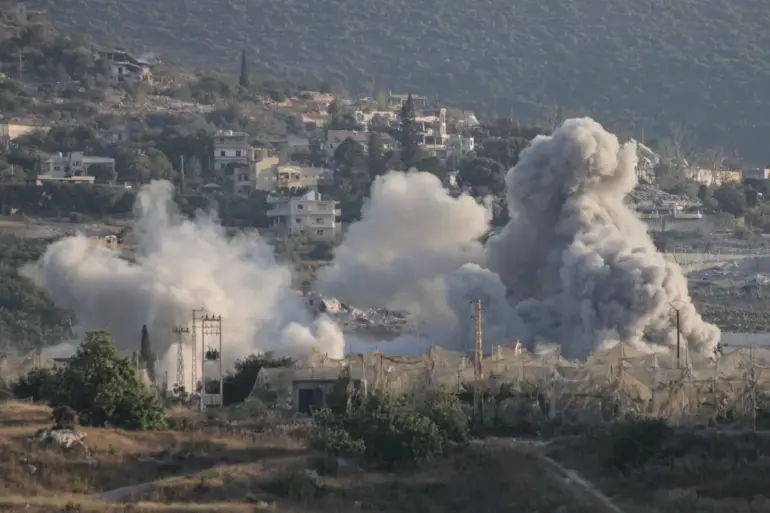
Iran and the United States traded threats on Wednesday as some of the heaviest fighting in weeks engulfed the Middle East, deepening the two foes’ stalemate six months into the war.
US President Donald Trump said American forces had carried out a “very heavy attack” on Iranian targets overnight and were “prepared to do another one any time we want”.
Tehran’s security chief, meanwhile, warned that Iran had adopted a “new strategy” in the war, which began in late February with US-Israeli attacks on the Islamic Republic.
“You will soon see that Iran’s new strategy on the battlefield, in diplomacy and in confronting the economic blockade will shatter your foundations,” Supreme National Security Council Secretary Mohsen Rezaei wrote on X.
Washington has vowed to intensify economic pressure on Iran, including by threatening its allies with sanctions.
US Energy Secretary Chris Wright said Wednesday that a plan to expand sanctions against Iran’s economic partners would deliver “absolutely maximum pressure”.
Trump also floated the idea of renaming the Strait of Hormuz — the vital oil waterway that Tehran has effectively shut for six months — as “Trump Strait”, although he later appeared to suggest he was not being serious.
“Now that we have it under U.S.A. control, should we change the name Hormuz Strait to TRUMP STRAIT???” the US president wrote on Truth Social.
Regional strikes
Iran targeted US bases in Jordan, the United Arab Emirates, Kuwait, Bahrain and Iraq’s autonomous Kurdistan region after extensive US bombardment of sites across Iran on Tuesday.
Tehran reacted furiously after the Iranian Red Crescent said a US strike that hit a wedding in the country’s south killed four people, including a child, and wounded more than 50 others.
“The truth of this unlawful war of choice — and the true face of the war crime — is in Sirik, where a wedding ceremony was brutally bombed as part of America’s desperate struggle to conceal its failure,” Foreign Ministry spokesman Esmaeil Baqaei wrote on X.
The US military did not directly address the incident.
US Central Command (CENTCOM) spokesman Tim Hawkins said: “The US military never targets civilians, unlike the IRGC,” referring to Iran’s Islamic Revolutionary Guard Corps.
‘Acts like satan’
Iran’s top negotiator, Mohammad Bagher Ghalibaf, lashed out at Washington over the wedding strike, calling the United States “Satan”.
“If a power acts like Satan, picks targets like Satan, and kills like Satan, it’s Satan,” he wrote on X.
The latest round of fighting began when Washington struck Iranian targets on Sunday, marking the first known US attacks in several weeks.
Iranian forces subsequently targeted US troops in Jordan and the United Arab Emirates. Projectiles also struck two oil tankers in attacks whose perpetrators were not immediately identified, killing two Filipino sailors in one incident, according to a Saudi shipping company.
Trump said the US strikes were carried out in retaliation for an Iranian attempt to plant sea mines in the Strait of Hormuz and for missile fire targeting a US base in Jordan.
‘Truly distressing’
Many Iranians expressed dismay at the return to hostilities.
Hossein Moazami, 50, a self-employed man, described the attacks as “truly distressing”.

“I hope they all return to the negotiating table because the only people suffering from this are the Iranian people,” he said. “The Americans are on the other side of the world, and nothing happens to them.”
A video shared by an Iranian government account showed debris and damage at what it identified as the wedding site in Sirik, with people heard screaming in the background.
“It is a very saddening incident… Thank God the casualties were not higher,” Ali Mallahi, the bride’s father and owner of the building that was hit, said in a video broadcast by state television.
The war began on February 28 with US-Israeli attacks on Iran that killed its supreme leader, Ayatollah Ali Khamenei.
A fragile ceasefire later collapsed following attacks on commercial vessels in the Strait of Hormuz, through which roughly one-fifth of the world’s oil supplies had previously flowed.
Meanwhile, Israel’s defence minister said his country was prepared to respond “with great force” if Iran attacked during the Jewish high holiday season, which begins in mid-September.
“For now, they are striking throughout the region except us,” Israeli Defence Minister Israel Katz told a conference hosted by Israeli media outlets.
AFP
