

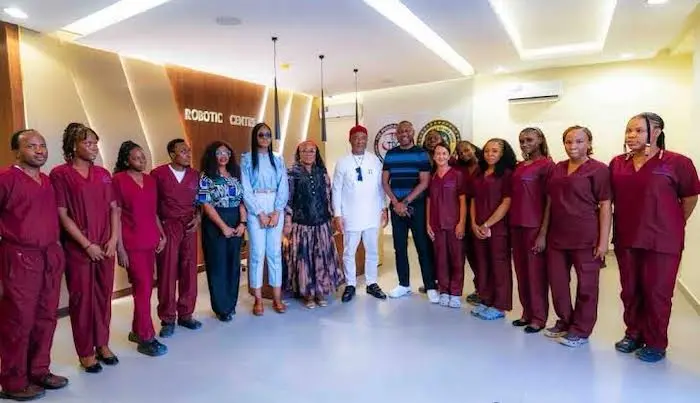
Imo State has recorded a major milestone in healthcare delivery with the successful completion of its first robotic-assisted surgery at the Imo Robotics and Oncology Centre (IROC), located within the Imo Specialist Hospital Complex, Umuguma, Owerri.
The landmark procedure, performed on Friday, August 21, 2026, was carried out by a team of Nigerian and international medical specialists led by Professor Kingsley Ekwueme, a UK-based consultant robotic and laparoscopic surgeon and an indigene of Imo State.
The development was disclosed in a statement issued by the Chief Press Secretary/Special Adviser (Media) to the Governor, Oguwike Nwachuku.
Speaking to journalists at the IROC after the procedure, Ekwueme described the operation as a “complete success,” highlighting the benefits of robotic-assisted surgery, particularly in the treatment of localised prostate cancer.
According to him, the technology allows surgeons to remove cancerous tissues with greater precision while preserving vital functions, including urinary and sexual control.
“The success rate of robotic surgery for cancer, especially prostate cancer, is phenomenal,” Ekwueme said, stressing that patients should not have to endure prolonged incontinence or loss of sexual function following prostate surgery.
Governor Hope Uzodimma, who witnessed the landmark procedure, described the achievement as a significant step towards providing Imo residents with access to quality and affordable specialised healthcare.
He said the facility was established not only to provide advanced treatment but also to promote early detection and disease prevention through routine medical check-ups.
According to the governor, the centre operates under a Public-Private Partnership (PPP) arrangement, with the majority of its funding coming from the private sector. He said the model would help ensure the facility’s sustainability and effective management.
Uzodimma urged residents to enrol in the Imo State Health Insurance Scheme, saying wider coverage would make advanced medical care more affordable and accessible.
He described the successful surgery as the result of strategic investments by his administration to transform healthcare delivery in the state.
The governor also emphasised that the state-of-the-art facility was designed not only to provide advanced medical care but also to serve as a centre for continuous training and skills transfer to local healthcare professionals.
“Our plan has never been to acquire sophisticated medical equipment and leave it idle. Equipment must be matched with competence, and technology must be matched with training,” he said.

Uzodimma noted that robotic-assisted surgery offers several advantages, including greater precision, minimally invasive procedures, reduced blood loss and faster recovery times.
He added that the Robotics and Oncology Centre forms part of a broader upgrade of the Imo Specialist Hospital Complex, which now includes expanded Intensive Care Units (ICUs), advanced diagnostic facilities, modern surgical theatres, neonatal care and specialised oncology departments.
The governor said the state would continue to expand healthcare coverage through the Imo Health Insurance Scheme, while strengthening its capacity to provide specialised medical services locally.
“The real measure of success will be in the patients treated, the skills transferred, the specialists developed, the lives improved, and the confidence that our people build in our local healthcare system,” Uzodimma said.
He added that the successful operation marked only the beginning of Imo State’s ambition to become a leading destination for specialised medical care.