

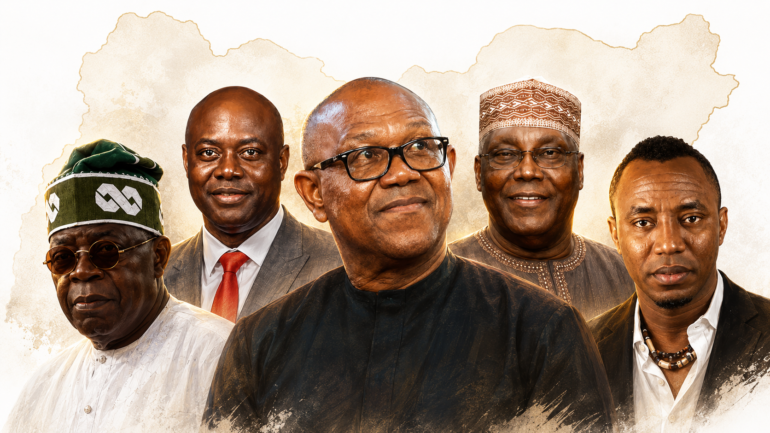
Nigeria’s political parties officially begin campaigning on Wednesday, setting the stage for a presidential election in January 2027 that is expected to be shaped largely by the cost of living, economic reforms, insecurity and the strength of the opposition.
President Bola Tinubu is seeking a second term after a first four years marked by sweeping economic changes, including the removal of the long-standing petrol subsidy and reforms to the foreign-exchange market.
While economists and investors have largely welcomed the measures as necessary steps to address longstanding distortions in Africa’s largest economy, millions of Nigerians have faced higher living costs as the reforms fed into a sharp rise in prices and weakened the naira.
Inflation, which climbed as high as 34 per cent during Tinubu’s first term, eased to 15.4 per cent in July. However, food, transport and other essential costs remain major concerns for households across the country.
“The economy is the biggest issue. That’s the one thing that cuts across different parts of the country, and it continues to affect security and development concerns,” said Afolabi Adekaiyaoja, author of The Bellwether, a newsletter focused on Nigerian politics.
The economic pressures have also deepened concerns about poverty. The World Bank estimates that more than 60 per cent of Nigerians now live below the poverty line, compared with about 40 per cent in 2019.
Security will be another major issue during the campaign. Nigeria continues to face attacks by jihadist groups in the northeast, kidnappings and armed banditry across parts of the north and centre, clashes between farmers and herders, and separatist violence in the southeast.
Ladd Serwat, a senior Africa analyst at conflict monitor ACLED, said violence had increased since 2024, particularly because of the spread and intensification of armed banditry across northern and central Nigeria and renewed fighting in Borno State, the centre of the country’s jihadist insurgency.
Despite the challenges confronting the government, Tinubu enters the campaign with significant political advantages. His All Progressives Congress controls the National Assembly and 31 of Nigeria’s 36 state governorships.
The opposition, meanwhile, remains divided. Several leading figures from the 2023 election are again preparing to challenge Tinubu, including former vice president Atiku Abubakar and former Anambra State governor Peter Obi.
Tinubu won the 2023 presidential election with 36.6 per cent of the vote, ahead of Abubakar with 29 per cent and Obi with 25 per cent. Rabiu Kwankwaso, who secured about six per cent, has since aligned with Obi and is expected to serve as his running mate.
Adekaiyaoja said opposition parties had been weakened by internal disputes and legal battles, making it difficult for them to present a unified alternative to Tinubu’s policies.
For many voters, however, political calculations remain secondary to everyday economic pressures.
“The most important issues for me are the economy and cost of living,” said Afolayan Abdullahi, a 42-year-old civil servant who plans to vote for Tinubu.
For others, insecurity could determine whether they vote at all.
“Nigeria is not safe — terrorists, kidnappers, bandits everywhere,” said Becky Alegbe, a 28-year-old street vendor in Abuja.
Alegbe is registered to vote in her home village in Edo State but said she was unwilling to make the journey because of security concerns and soaring transport costs. She also pointed to fears over vote-buying, which have repeatedly raised concerns around Nigerian elections.
Voter participation was particularly low in 2023, when turnout fell to about 27 per cent.
Peace accord sets tone for campaign
The start of campaigning follows the signing of a national peace accord by presidential candidates and other political actors in Abuja on Tuesday.
Tinubu, Obi, African Action Congress candidate Omoyele Sowore and Peoples Redemption Party candidate Donald Duke were among those represented at the event, which also brought together other presidential candidates, governorship and National Assembly contenders, political party leaders and senior government officials.
The agreement was organised by the National Peace Committee, which has promoted peaceful political competition in Nigeria since 2014. A second phase of the initiative is expected after the 2027 elections.
The Independent National Electoral Commission chairman, Joash Amupitan, Secretary to the Government of the Federation George Akume and other senior political figures also attended the ceremony.
Obi called for an election in which voters could have confidence that their ballots would determine the outcome.
“I don’t have any fear [going into next year’s election] except to say that, please, for the sake of the children of Nigeria, can we have an election where people’s votes will count?” he said.
He also urged Nigerians to reject candidates who violate the peace agreement, arguing that voters should provide the ultimate punishment at the ballot box.
“The punishment is that Nigerians should not vote for them,” Obi said.
He called on all candidates to lead by example as the election approaches.
“You can’t answer ‘His Excellency’ without being an excellent person,” Obi said. “So, the process that will make you answer ‘His Excellency’ should be excellent, and the only way to do it is to conduct yourself properly.”
Tinubu, represented at the ceremony by Akume, commended the National Peace Committee and its leaders, including former military head of state Abdulsalami Abubakar, Sultan of Sokoto Muhammad Sa’ad Abubakar and Bishop Matthew Hassan Kukah, for maintaining the peace initiative.
He also highlighted improvements in Nigeria’s electoral system, particularly the use of technology such as the Bimodal Voter Accreditation System.
Tinubu pointed to recent off-cycle elections in Anambra, Osun and Ekiti, where different political parties emerged victorious, as evidence that Nigeria’s electoral process is becoming more transparent.
“When the process and outcome are manifestly transparent, we see less post-election litigation in our courts,” he said, adding that greater electoral transparency had made politicians more accountable because “votes count.”
With campaigning now underway, the contest is likely to revolve around whether Tinubu’s economic reforms can deliver broader benefits to Nigerians, how effectively his administration has tackled insecurity and whether a fragmented opposition can convert widespread public frustration into a credible electoral challenge.