

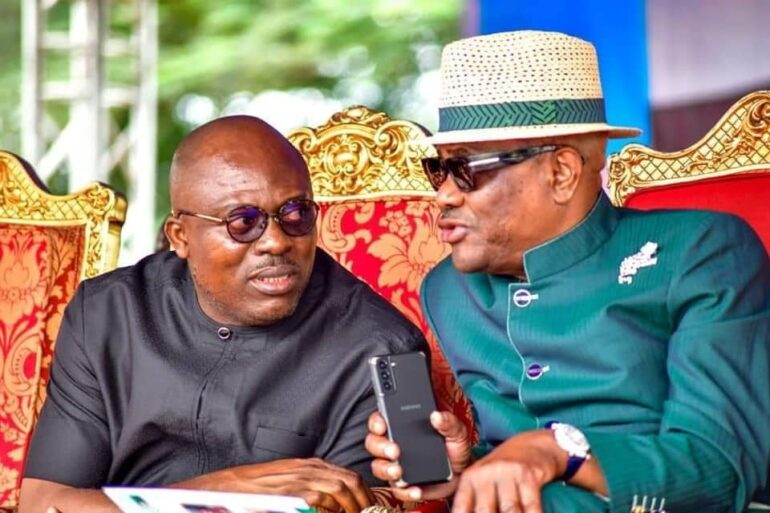
The Minister of the Federal Capital Territory (FCT), Nyesom Wike, has identified what he described as the major mistakes made by his successor as Rivers State governor, Siminalayi Fubara, attempting to operate independently and moving too quickly to establish his own political structure after assuming office.
Wike said he was surprised that Fubara began efforts to build his own political network less than 100 days after taking over as governor, arguing that the move showed a disregard for the political structure and individuals that supported his emergence.
The FCT minister made the remarks during a special media chat in Port Harcourt, the Rivers State capital, on Saturday.
According to Wike, he left behind a strong foundation and expected Fubara to continue with ongoing projects aimed at positioning Rivers State to compete with Lagos in infrastructure development.
He cited the multi-billion-naira Port Harcourt Ring Road project, which links several local government areas, as one of the legacy projects he initiated before leaving office.
Wike also highlighted the construction of 12 flyovers across the state, all of which were completed and commissioned during his tenure, saying the projects transformed the appearance and infrastructure of Port Harcourt and surrounding areas.
The former governor said politicians must be careful about the advice they receive, especially from individuals who may not genuinely support their success.
He recalled that before handing over power, he advised Fubara to build on the achievements of his administration and pledged his support for the new government.
“Before I handed over to Governor Fubara, we had a church service and I said: you have been elected. In a few days, you will be sworn in. What do you want to achieve? See where I have stopped. My thinking is that we need to compete with Lagos. We have laid the foundation; he should be able to continue from there, and we will give you all the necessary support,” Wike said.
Wike accused some individuals of encouraging Fubara to distance himself from those who helped him attain office, including people he claimed were interested in occupying the governor’s position.
He said leaders must carefully evaluate advice from those around them and consider the consequences of their decisions.
“If you make the mistake which he made by saying, ‘I can do it alone; those who gave me support, I don’t care, I don’t need them,’ those who didn’t want you will come in. There is no way anybody who didn’t want you to be in a position will want you to succeed,” he said.
Wike added that Fubara attempted to create a new political structure instead of strengthening the one that brought him to power.
“He tried to do it by himself and wanted to set up his own structure as against the structure that built him. In fact, it did not take up to 100 days and we saw it. We said something must be fundamentally wrong,” he said.

The minister also dismissed allegations that he demanded money from Fubara, describing such claims as a common tactic used during political disagreements.
He said his interest was not financial but ensuring stability and continuity in Rivers State.
“If it was money that we were asking for, we wouldn’t have prevailed. What we wanted was to stabilise the place, move on from where I stopped, and build on the foundation I laid so we could compete with Lagos,” Wike said.
He noted that the FCT, under his leadership, had significantly increased its internally generated revenue (IGR), rising from about N8 billion monthly when he assumed office to about N40 billion monthly, which he attributed to effective administration.
Wike concluded that the political crisis involving Fubara had slowed Rivers State’s progress and widened the gap between the state and Lagos in terms of development.