

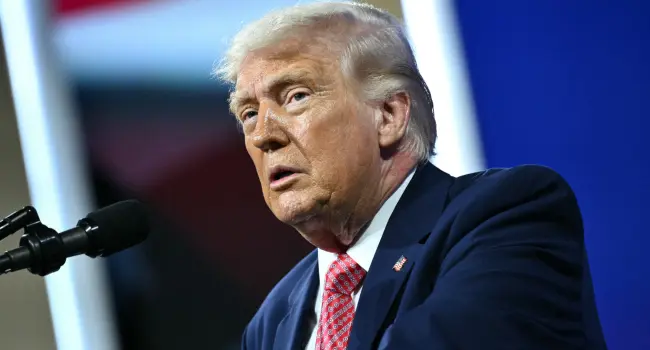
The US Senate on Tuesday approved a largely symbolic resolution calling for an end to President Donald Trump’s military engagement with Iran, delivering a fresh rebuke to the White House as it pursues a broader diplomatic settlement with Tehran.
The measure, passed in a 50–48 vote after clearing the House, directs Trump to withdraw US forces from hostilities with Iran unless Congress explicitly authorises further military action.
Because it is a concurrent resolution, it does not require presidential approval and carries contested legal force. However, its passage places both chambers of Congress on record opposing a conflict that began with US and Israeli strikes on Iran in late February and has since fuelled regional tensions involving Lebanon and Gulf states, while rattling global energy markets.
During Trump’s first term, Congress passed War Powers resolutions in 2019 and 2020 seeking to limit military action in Yemen and Iran, but both were vetoed by the president and the Senate failed to override them.
Trump criticised the latest vote on his Truth Social platform, describing it as “poorly timed and meaningless.”
“These Senators have just made my job more difficult, but I will get it done, one way or the other, because I always get it done!” he wrote.
The vote came as the Trump administration continues a 60-day diplomatic push to convert a preliminary memorandum of understanding with Iran into a final agreement covering Tehran’s nuclear programme, sanctions relief and access to the Strait of Hormuz.
Senate Democratic Leader Chuck Schumer led efforts to bring the resolution to a vote, aiming to put Republicans on record after some Trump allies expressed concern over both the conflict and the administration’s handling of negotiations.
“Republicans can complain about Trump’s war, his secrecy, and his disastrous deal with Iran all they want behind closed doors, but the only way to ensure this war ends once and for all is for Republicans to act,” Schumer said in a floor speech ahead of the vote.
The resolution had earlier passed the Republican-controlled House, where four Republicans joined Democrats in support—an uncommon break with Trump on national security matters.
Democrats argue that Trump violated the Constitution by launching military operations against Iran without congressional approval.
War powers debate
Under the 1973 War Powers Resolution, presidents must seek congressional authorisation within 60 days of introducing US forces into hostilities, though successive administrations have disputed its interpretation and scope.
The White House has argued that congressional attempts to limit Trump’s authority are unconstitutional, maintaining that hostilities with Iran effectively ended under an April ceasefire declared by the president.
It also warned that restricting executive powers could weaken US leverage in ongoing negotiations with Tehran.
House Speaker Mike Johnson, a Trump ally, described efforts to constrain the president during sensitive talks as a “very dangerous prospect” ahead of the vote.
However, Democrats and some Republicans insist that fighting continued beyond legal limits and point to repeated threats of renewed strikes by Trump.
The debate reflects growing unease in Congress over the economic impact of the conflict, which has disrupted trade routes, pushed up energy prices and added to inflation concerns ahead of November’s midterm elections.

Ongoing diplomatic tensions
The administration’s negotiations with Tehran have advanced rapidly since Trump and Iranian President Masoud Pezeshkian signed a preliminary agreement intended to halt wider regional fighting and reopen the Strait of Hormuz.
However, significant disagreements remain.
Iran said on Tuesday that UN nuclear inspectors would not be allowed access to sites bombed by the United States and Israel last year, rejecting Vice President JD Vance’s claim that Tehran had agreed to renewed inspections.
Trump, meanwhile, insisted on social media that Iran had agreed to “the highest level” of nuclear oversight.
Separately, Iran’s chief negotiator Mohammad Bagher Ghalibaf said the Strait of Hormuz would “never return” to pre-war conditions of unrestricted passage, despite ongoing diplomatic efforts to secure maritime stability in the region.
AFP