

The World Health Organization on Friday raised its risk assessment for the deadly Ebola outbreak in the Democratic Republic of the Congo to the highest level, as infections and deaths continue to rise.
The WHO upgraded the national risk level in the DRC from “high” to “very high”, while maintaining the regional risk level at “high” and the global risk level at “low”.
WHO Director-General Tedros Adhanom Ghebreyesus described the situation as “deeply worrisome”, warning that the outbreak was spreading rapidly despite ongoing containment efforts.
Speaking at a press conference, Tedros said 82 Ebola cases and seven deaths had so far been confirmed in the DRC. However, health authorities believe the actual scale of the outbreak is far greater, with nearly 750 suspected cases and 177 suspected deaths under investigation.
“The Ebola outbreak in the Democratic Republic of the Congo is spreading rapidly,” he said, noting that health workers were struggling to trace and monitor contacts of infected persons.
Tedros added that the situation in neighbouring Uganda remained stable, with only two confirmed imported cases linked to travellers from the DRC, including one death.
According to him, measures such as intensive contact tracing and the cancellation of Martyrs’ Day celebrations in Uganda appear to have helped prevent further spread of the virus.
The WHO also confirmed that a U.S. national working in the DRC tested positive for Ebola and had been transferred to Germany for treatment, while another American considered a high-risk contact was moved to the Czech Republic for monitoring.
Tedros disclosed that 22 international health experts, including experienced outbreak response personnel, had been deployed to affected areas in the DRC to support local authorities.
However, he warned that violence and insecurity in parts of eastern Congo were severely hampering response efforts.
Ebola is a highly infectious viral disease spread through direct contact with bodily fluids and can cause severe bleeding, organ failure and death.
The current outbreak involves the rare Bundibugyo strain of Ebola, for which there are no approved vaccines or treatments. Previous outbreaks of the strain were recorded in Uganda in 2007 and the DRC in 2012.
WHO Chief Scientist Sylvie Briand said the agency was assessing available medical tools and prioritising possible treatments based on safety and effectiveness.
She disclosed that WHO’s technical advisory group had recommended two monoclonal antibody treatments for clinical trials and was also evaluating the antiviral drug obeldesivir as a possible preventive treatment for high-risk contacts.
Briand said the antiviral showed promising potential in preventing infected persons from developing the disease.
The WHO is also in discussions with partners on the possible development of vaccines targeting the Bundibugyo strain.
Meanwhile, tensions are rising in parts of the DRC as fear, misinformation and public distrust complicate containment efforts.

Rioters on Thursday reportedly set fire to isolation tents at Rwampara Hospital in Ituri Province, one of the epicentres of the outbreak, after the death of a 24-year-old man suspected to have died from Ebola.
According to hospital officials, the deceased’s family demanded the release of his body for burial, but health workers refused in line with Ebola safety protocols.
The confrontation escalated into violence before soldiers intervened to disperse the crowd. A nurse was reportedly injured by stones thrown during the unrest.
In many rural communities, residents remain sceptical about the disease, with some dismissing Ebola as “imaginary” despite mounting fatalities.
Health experts say traditional burial practices involving physical contact with corpses continue to fuel transmission in affected areas.
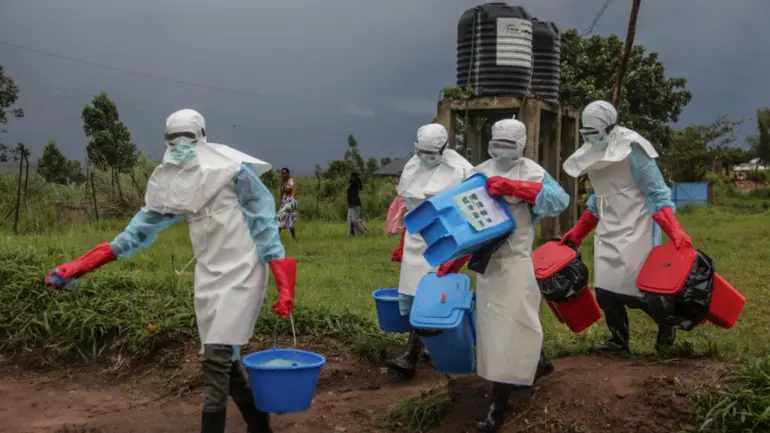
Under heavy security, healthcare workers later carried out emergency burials for suspected Ebola victims while grieving relatives watched from a distance.
Residents have also criticised authorities over inadequate medical facilities and delayed response efforts, warning that suspected Ebola patients are still being mixed with other hospital patients in some overcrowded wards, increasing the risk of further infections.