

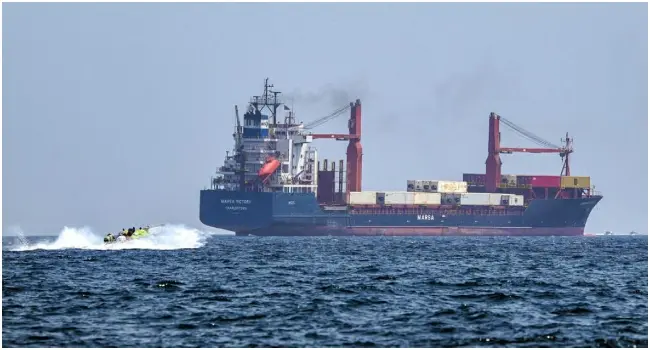
Iran’s military declared on Saturday that the Strait of Hormuz had been closed again, just hours after announcing its reopening, as several commercial vessels abandoned attempts to transit the vital waterway.
The conflicting announcements have added to uncertainty surrounding US President Donald Trump’s claims that a peace deal to end the US-Israeli conflict with Iran was “very close.”
On Friday, Tehran had said the strait, through which about a fifth of global oil and liquefied natural gas passes was open following a ceasefire agreement in Lebanon aimed at halting Israel’s war with Hezbollah.
The announcement initially boosted global markets and sent oil prices sharply lower. Trump, however, insisted that a US naval blockade of Iranian ports would remain in place until a deal was reached, prompting Tehran to threaten renewed restrictions on the strait.
By Saturday morning, Iran’s central military command said control of the waterway had “returned to its previous status” and was “under strict management and control of the armed forces,” effectively signalling a reversal.
Maritime tracking data showed mixed movements through the corridor, with at least eight oil and gas tankers successfully crossing by 10:30 GMT, while several others turned back after attempting to exit the Gulf.
Adding to the uncertainty, the UK Maritime Trade Operations (UKMTO) reported that a tanker northeast of Oman had been approached by two Iranian Revolutionary Guard vessels without radio communication and came under fire. The ship and crew were reported safe, with investigations ongoing.
Iranian Deputy Foreign Minister Saeed Khatibzadeh, speaking at a diplomatic forum in Turkey, said the United States “cannot impose its will over Iran” through pressure or blockade.
In a separate message, Iran’s supreme leader Mojtaba Khamenei said the country’s navy remained ready to confront US forces, describing Iran’s position as firm and defensive.
Diplomatic push continues
Despite the uncertainty, diplomatic efforts continue as the ceasefire enters its final days. President Trump has expressed optimism that a comprehensive agreement is within reach, describing recent developments as “great and brilliant” and praising Pakistan’s role in mediation.
Pakistan’s military chief, Field Marshal Asim Munir, recently concluded a three-day visit to Iran aimed at supporting negotiations.
Egypt has also been involved in mediation efforts. Foreign Minister Badr Abdelatty said Cairo and Islamabad hope to finalise a deal “in the coming days.”
However, Iranian officials said no date has been fixed for the next round of direct talks.

War context and regional tensions
The conflict began after a US-Israeli military campaign launched on February 28, which Tehran says killed Iranian Supreme Leader Ali Khamenei and several senior officials. The war quickly expanded across the region, drawing in Hezbollah in Lebanon and prompting Iranian strikes on US interests in the Gulf.
Although a fragile ceasefire is currently in place, key issues remain unresolved, particularly Iran’s enriched uranium stockpile and the status of the Strait of Hormuz.
Trump has claimed Iran agreed to hand over around 440 kilograms of uranium enriched to 60 percent, but Iranian officials have rejected this, insisting the material will remain under Iranian control.
Foreign ministry spokesperson Esmaeil Baqaei said: “Transfer of Iran’s enriched uranium to the US has never been raised in negotiations.”
Meanwhile, internet restrictions imposed at the start of the conflict remain in place, with monitoring groups reporting a prolonged nationwide blackout.
AFP