

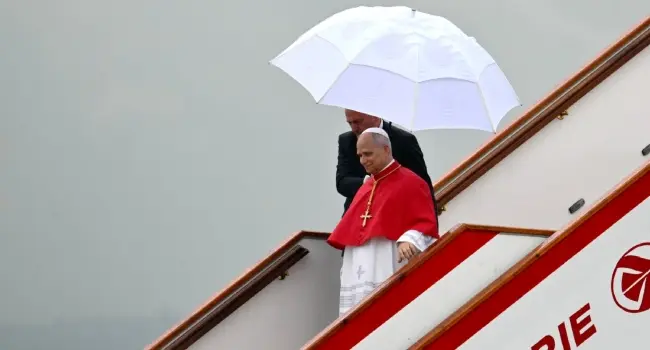
Pope Leo XIV arrived in Algeria on Monday, beginning an 11-day tour of Africa, a major international trip that was already at risk of being overshadowed by criticism from US President Donald Trump.
Leo becomes the first leader of the global Catholic Church to visit the Muslim-majority country, where he is expected to promote efforts to “build bridges between the Christian and Muslim worlds,” according to Archbishop of Algiers Jean-Paul Vesco.
But just hours before departing Rome at around 0700 GMT, the pontiff became the target of unusually public criticism from Trump, who condemned Leo’s calls for an end to violence in the Iran conflict.
“I’m not a big fan of Pope Leo,” Trump told reporters, accusing him of “toying with a country (Iran) that wants a nuclear weapon.”
Trump later suggested that cardinals elected Leo in May 2025 partly because he is American and could serve as a bridge to Washington. He also posted an AI-generated image that appeared to depict himself as Jesus Christ.
Leo has previously described Trump administration threats against civilians in Iran as “unacceptable,” though he did not name the president directly, and has also criticised its “inhuman” treatment of migrants.
In what many interpreted as a gesture of support, Italian Prime Minister Giorgia Meloni — a far-right leader considered close to Trump, issued a statement on Monday wishing the pope success on his four-nation African tour.
“May the Holy Father’s ministry foster the resolution of conflicts and the return of peace, both within and between nations, following the path traced by his predecessors, and provide support and comfort to the Christian communities he will encounter during his journey,” she said.
Personal significance
The pope’s trip spans Algeria, Cameroon, Angola, and Equatorial Guinea, covering more than 18,000 kilometres (11,000 miles) between April 13 and 23.
His first stop is Algiers, where he is scheduled to meet President Abdelmadjid Tebboune, address diplomats, and pay tribute to victims of Algeria’s 1954–1962 war of independence from France.
In the capital, preparations for the historic visit were already visible, with freshly painted walls, repaved roads, and public spaces decorated with flowers and plants.
The Algeria visit also carries deep personal meaning for Leo, as the country is closely associated with Saint Augustine (354–430), whose theological legacy strongly shapes his pontificate.
The influential Christian thinker laid the foundations for the 13th-century Augustinian order to which Leo belongs, a community centred on shared life and service.
In his first speech as pope, Leo described himself as a “son” of Augustine and frequently cites his writings. Before becoming pope, the former Robert Francis Prevost visited Algeria twice as head of the order.
On Tuesday, he will travel to Annaba, the ancient Roman city of Hippo and former home of Augustine, whose Confessions remains a foundational Christian text.
Father Fred Wekesa, rector of the Saint Augustine Basilica in Annaba, where Leo will celebrate Mass, said the visit would bring his small congregation a “message of encouragement and solidarity.”
‘Capable of peace’
Monday’s programme also includes visits to the Great Mosque of Algiers, home to the world’s tallest minaret, and the Basilica of Our Lady of Africa, overlooking the Bay of Algiers.
Leo is also expected to pray privately in a chapel dedicated to 19 priests and nuns killed during Algeria’s 1992–2002 civil war.
He will not visit the Tibhirine monastery, where seven monks were kidnapped and murdered in 1996, an event that remains unresolved and continues to cast a shadow over Algeria’s so-called “black decade,” during which an estimated 200,000 people were killed.
Wekesa acknowledged that Algeria is still often viewed through the lens of those “dark years,” but said the pope’s visit would instead highlight “the hospitality and generosity of the Algerian people.”
“We are capable of living together in peace,” he said.
Although Algeria’s constitution guarantees freedom of worship under certain conditions, human rights groups say restrictions on religious minorities persist. Three organisations urged Leo last week to raise the issue during his visit.
AFP