

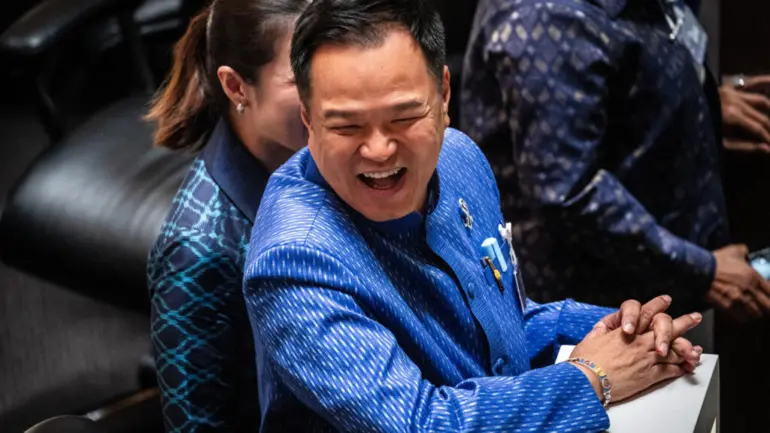
Thailand’s new parliament on Thursday elected Anutin Charnvirakul as Prime Minister, keeping the conservative leader in office after his Bhumjaithai party delivered a commanding performance in February’s elections.
“This parliament has voted for Anutin Charnvirakul to become prime minister,” House Speaker Sophon Zaram announced, noting that Anutin secured 293 votes, more than half of the ballots cast. His progressive rival, Natthaphong Ruengpanyawut, received 119 votes, while 86 MPs abstained.
Anutin, 59, told reporters, “I hope to remain in my position to serve the people for as long as I can. Those who know me understand that whenever there is a problem affecting the public, I will respond immediately to their needs.”
The new government faces immediate challenges, including the global economic fallout from the Middle East war, sluggish growth at home, and lingering border tensions with Cambodia.
Anutin’s Bhumjaithai party, known for its pro-military and pro-monarchy stance, achieved its strongest electoral showing ever, campaigning on pledges to fortify the Cambodian frontier, close border crossings, and recruit 100,000 volunteer soldiers.
The Pheu Thai party, led by jailed former Prime Minister Thaksin Shinawatra’s daughter, Paetongtarn Shinawatra, agreed to join Anutin’s coalition alongside 14 smaller parties, allowing him to secure the premiership. The People’s Party, a reformist group that had been leading in pre-election polls, will head the opposition.
Anutin, a millionaire heir who previously championed cannabis decriminalisation, first assumed office in September after Paetongtarn was removed by court order over an ethics complaint. Following the coalition fallout, he has now returned to power with a strengthened mandate.
Economic and security challenges
Thailand’s economy slowed last year, and the new administration faces a struggling tourism sector and competition for foreign investment from Vietnam. The ongoing Middle East conflict has also disrupted fuel supplies and raised prices, putting pressure on households and businesses.
Political scientist Yuttaporn Issarachai noted, “The cabinet’s priority is now addressing these external challenges. So far, the government has offered only ‘band-aid’ measures, such as work-from-home advisories, to curb rising fuel costs.”
The border conflict with Cambodia remains unresolved, despite a fragile ceasefire. Last December, Thailand’s military took control of several disputed areas along the 800-kilometre boundary.
“While the border is important, the economy has now become the public’s top priority,” Yuttaporn added.
AFP