

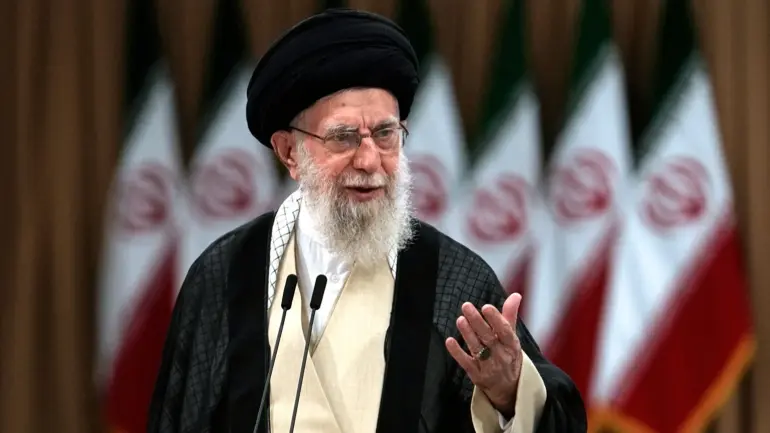
Iran’s top officials on Sunday vowed retaliation after the reported killing of Supreme Leader Ali Khamenei, announcing a fresh wave of strikes on US military bases in the Gulf despite President Donald Trump’s warning of “unprecedented” force.
Explosions rocked Tehran as large crowds gathered in the capital, while the Israeli military said it was carrying out new strikes in the heart of the city. Blasts were also reported in Jerusalem, Riyadh, Dubai, Doha and Manama, underscoring the widening regional fallout.
Iranian President Masoud Pezeshkian described Khamenei’s killing as a “declaration of war against Muslims” and said Tehran regarded it as its “legitimate duty and right” to punish those responsible.
Ali Larijani, head of Iran’s Supreme National Security Council, said the country would deliver “an unforgettable lesson to the international oppressors.” In a social media post echoing Trump’s combative style, he warned that Iran would strike back with force “never experienced before.”
Smoke was seen rising from a building in northern Tehran following fresh explosions, according to an AFP journalist, though the precise target was not immediately clear.
Threat of escalation
While some Iranians were initially reported to have cheered early, unconfirmed reports of Khamenei’s death, state media confirmation prompted pro-government demonstrations, with crowds chanting “Death to America!” and demanding retaliation.
Iran’s armed forces announced strikes targeting US bases in the Gulf and in Iraqi Kurdistan. Trump, in response, threatened overwhelming retaliation and urged Iranians to “rise up” against their leaders.
Iran’s initial counterstrikes on Saturday reportedly hit all Gulf states except Oman, which had been mediating US-Iran talks. On Sunday, however, Oman’s commercial port of Duqm was struck by two drones, injuring a foreign worker, according to the Oman News Agency. A tanker off the sultanate’s coast was also reportedly hit.
The wave of US and Israeli strikes that allegedly killed the 86-year-old cleric and other senior Iranian figures triggered unrest beyond Iran’s borders. In Iraq and Pakistan, demonstrators attempted to storm US diplomatic missions.
In Karachi, at least eight people were killed during clashes near the US consulate, most of them from gunshot wounds, according to local rescue officials.
Iran’s Red Crescent said Israeli and US strikes had killed 201 people and wounded hundreds more nationwide. The judiciary confirmed that senior adviser Ali Shamkhani and Revolutionary Guards commander General Mohammad Pakpour were among those killed.
Iran responded with missile and drone attacks across the region, reportedly killing at least two people in Abu Dhabi and another in Tel Aviv before launching a further barrage after confirmation of Khamenei’s death.

Uncertain succession
Even before the reported killing, speculation had mounted over Khamenei’s successor given his age and health. Analysts say his death could significantly strengthen the role of the Islamic Revolutionary Guard Corps, which wields vast political and economic influence.
State television said President Pezeshkian and two other senior officials would oversee a transitional period.
In exile, Reza Pahlavi, son of the late shah overthrown in the 1979 Islamic Revolution, declared the Islamic Republic effectively finished and dismissed any successor chosen within the current system as illegitimate. Pahlavi has long positioned himself as a transitional figure toward a secular democracy, though his support among opposition factions remains mixed.
Meanwhile, Iran’s judiciary said a strike on a school in the south of the country killed 108 people. The toll could not be independently verified, and the circumstances surrounding the incident remain unclear.