

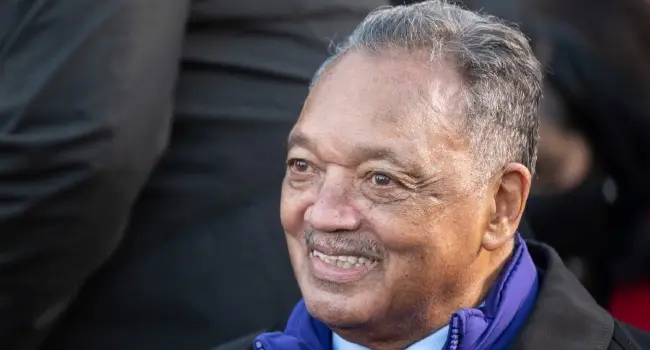
Veteran US civil rights activist Reverend Jesse Jackson has died at the age of 84, his family confirmed on Tuesday.
“His unwavering belief in justice, equality, and love uplifted millions,” Jackson’s family said in a statement. “We ask you to honor his memory by continuing the fight for the values he lived by. Our father was a servant leader, not only to our family, but to the oppressed, the voiceless, and the overlooked around the world.”
A close associate of Martin Luther King Jr. in the 1960s, Jackson was a dynamic orator, a successful mediator in international disputes, and a longtime Baptist minister who expanded the space for African Americans on the national stage for over six decades.
Jackson was present at many pivotal moments in America’s civil rights journey: he was with King in Memphis in 1968 when the civil rights leader was assassinated, wept openly in the crowd as Barack Obama celebrated his 2008 presidential victory, and stood alongside George Floyd’s family in 2021 after the conviction of the ex-police officer who murdered Floyd.
“My constituency is the desperate, the damned, the disinherited, the disrespected, and the despised,” Jackson said at the 1984 Democratic National Convention.
Rising to prominence through King’s Southern Christian Leadership Conference, Jackson later launched two social justice organizations: Operation PUSH in 1971 and the National Rainbow Coalition in 1983. The two merged in 1996 to continue advocating for civil rights and economic empowerment.
Jackson’s presidential campaigns also brought him national attention. He finished third in the 1984 Democratic primaries, becoming the most successful Black presidential candidate until Obama, and came in second in 1988, urging Americans to find “common ground” while criticizing policies he described as favoring the wealthy at the expense of the poor.
Despite his groundbreaking work, Jackson’s career was not without controversy. In 1984, he drew criticism for using a pejorative term for Jews, and his son, former Congressman Jesse Jackson Jr., served prison time in 2013 for misusing campaign funds.
Born Jesse Louis Burns on October 8, 1941, in Greenville, South Carolina, Jackson faced hardship early in life. He was raised by his mother and stepfather, Charles Jackson, who gave him his last name. A high-achieving student, he earned a football scholarship to the University of Illinois before transferring to North Carolina Agricultural and Technical State University, where he studied sociology.
Jackson’s activism began in the early 1960s with sit-ins in Greenville and continued with the Selma-to-Montgomery marches in 1965, catching King’s attention. He later became a mediator and envoy on international issues, advocating for the end of apartheid in South Africa and serving as presidential special envoy for Africa under Bill Clinton. He also undertook missions to free US prisoners in Syria, Iraq, and Serbia.
Even in his later years, Jackson remained active. Despite announcing in 2017 that he was battling Parkinson’s disease, he stood with George Floyd’s family during the 2021 trial verdict, describing it as “relief, but not a time for celebration.”
Jackson leaves behind a legacy as one of the most influential civil rights leaders in American history, remembered for his oratory, activism, and relentless pursuit of justice.
AFP