

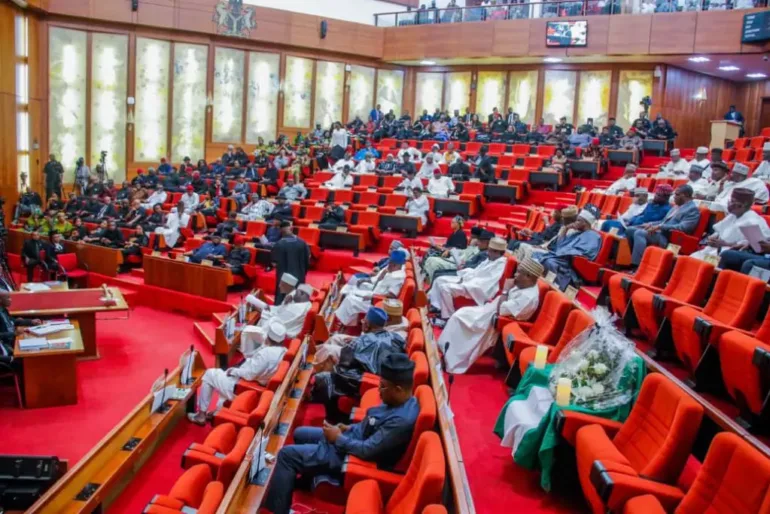
The Senate will on Tuesday (today) hold an emergency plenary session amid escalating national outrage over its handling of amendments to the Electoral Act, particularly its decision to drop the clause mandating real-time electronic transmission of election results.
The extraordinary sitting comes less than a week after the Senate passed the Electoral Act Amendment Bill, 2026, and follows mounting pressure from civil society organisations, opposition parties, labour unions, professional bodies, regional leaders and a growing youth-led protest movement that has taken its grievances to the gates of the National Assembly.
Senate President Godswill Akpabio is expected to preside over the plenary, which will be attended by the remaining 105 senators.
In the past six months, the Senate has lost two members, Senator Okechukwu Ezea (Enugu) and Senator Godiya Akwashiki (Nasarawa) to death, while Senator Jimoh Ibrahim recently exited the chamber following his appointment as an ambassador-designate. The development reduced the Senate’s membership from 109 to 106.
The emergency sitting was formally announced on Sunday in a notice signed by the Clerk of the Senate, Emmanuel Odo.
“The President of the Senate, Godswill Akpabio, has directed the reconvening of plenary for an emergency sitting on Tuesday, February 10, 2026,” the notice stated, adding that proceedings would commence at 12 noon.
Senators under pressure
The decision to reconvene comes amid intense backlash since the Senate passed the Electoral Act Amendment Bill after deleting the words “real-time” from provisions governing electronic transmission of results.
Findings indicate that several senators, particularly members of the conference and harmonisation committees have come under sustained pressure after their personal phone numbers circulated on social media, triggering a flood of angry calls, threats and verbal attacks from citizens accusing them of undermining democracy. Some lawmakers reportedly switched off their phones to avoid further harassment.
“The reactions were unpredictable. Some callers were laying curses, asking, ‘How do you sleep at night after this?’” a National Assembly source said.
Despite repeated assurances by Senate leaders that electronic transmission was not rejected outright, public distrust has continued to deepen, with critics warning that removing “real-time” creates loopholes for post-election manipulation.
The Nigeria Labour Congress (NLC) has warned of nationwide protests and possible election boycotts if the Senate fails to clearly reinstate mandatory electronic transmission of results, accusing lawmakers of sowing confusion and eroding public confidence through conflicting explanations.
Obi joins protest
Public anger spilled into the streets on Monday as a coalition of political activists under the banner of the Movement for Credible Elections (MCE) staged a mass protest in Abuja tagged “Occupy NASS.”
The demonstration gained fresh momentum when former Labour Party presidential candidate Peter Obi joined hundreds of protesters at the National Assembly complex.
The protesters, drawn largely from the Obidient Movement and other pro-democracy groups accused lawmakers of deliberately weakening electoral safeguards ahead of the 2027 general elections. Chanting solidarity songs and waving placards reading “Our votes must count,” “No to electoral robbery,” and “Protect democracy now,” they marched from the Federal Secretariat to the National Assembly.
A heavy security presence, comprising personnel of the Nigeria Police Force, Nigerian Army and the Nigeria Security and Civil Defence Corps, prevented them from entering the complex.
Addressing journalists outside the barricaded gates, Obi warned of a steady erosion of Nigeria’s democratic gains.
“We must dismantle this criminality and prove that we are now a nation that shows light in Africa,” he said.
The National Coordinator of the Obidient Movement Worldwide, Dr Yunusa Tanko, warned that protests would persist until lawmakers explicitly restore real-time electronic transmission of results.
“If there is no electronic transmission of results, there will be no election. Our elections must be credible,” Tanko said.
Civil society issues ultimatum
Away from the streets, leading civil society organisations intensified pressure on lawmakers, issuing a two-week ultimatum to conclude amendments to the Electoral Act and retain mandatory real-time electronic transmission of results.
The demand was made at a press conference in Abuja by a coalition including Yiaga Africa, the Kukah Centre, TAF Africa, International Press Centre, Centre for Media and Society, Nigerian Women Trust Fund, and Elect Her.

Speaking for the coalition, TAF Africa Founder and CEO, Jake Epelle, urged members of the conference committee to rise above partisan interests.
“We call on the conference committee to be guided by national interest, institutional integrity and democratic accountability,” Epelle said, urging lawmakers to transmit the final bill to the President within two weeks.
Yiaga Africa’s Director of Programmes, Cynthia Mbamalu, described the Senate’s position as legislative backsliding.
“It is unfair to take Nigerians backwards on an issue already settled in the last reform process,” she said, noting that INEC had previously indicated its readiness for electronic transmission.
Editors, regional leaders warn
The Nigerian Guild of Editors warned that the controversy was already breeding mistrust and could discourage voter participation. In a statement signed by its President, Eze Anaba, the guild said Nigerians were watching the National Assembly closely.
Similarly, the Southern and Middle Belt Leadership Forum demanded the retention of compulsory real-time transmission, warning against what it described as tampering with the bill.
Human rights lawyer and Senior Advocate of Nigeria, Ebun-Olu Adegboruwa, described electronic transmission as non-negotiable.
“At this stage of our political development, this should not even be a subject of debate,” he said.
Defining moment
The crisis centres on Section 60 of the Electoral Act Amendment Bill. While the House of Representatives retained mandatory real-time transmission, the Senate opted to preserve the discretionary framework of the 2022 Act.
With a joint conference committee set to meet this week, today’s emergency plenary is widely seen as a defining moment that could either restore confidence in Nigeria’s electoral reforms or deepen public distrust ahead of the 2027 elections.