

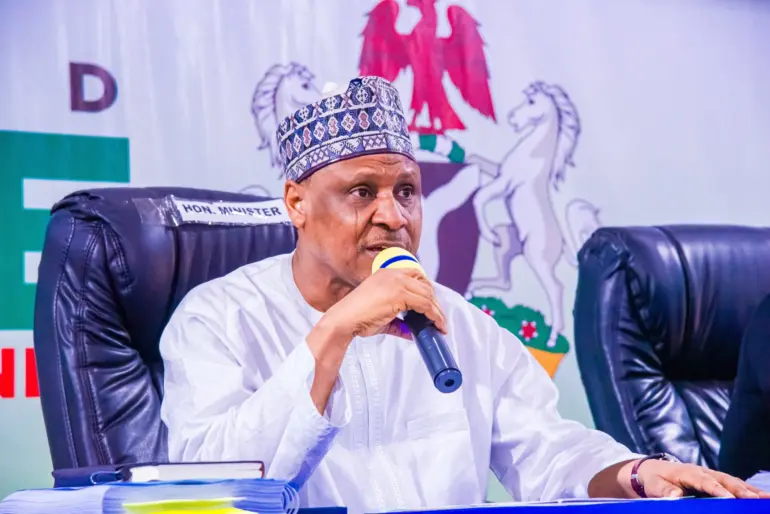
The Federal Government says it is in discussions with authorities of the United States following the recent military threat issued by US President Donald Trump.
The Minister of Information and National Orientation, Mohammed Idris, disclosed this in an interview with Sky News, noting that diplomatic engagement is ongoing to ease tensions between the two countries.
“Channels of communication have been opened. I can confirm that we are talking with them, and I think they are understanding the situation better,” Idris said.
He attributed the misunderstanding to a lack of appreciation of Nigeria’s diversity and the complexity of its internal security challenges.
“We believe that most of the information is a result of a lack of proper understanding of the diversity and complexity of the problem we have at hand,” the minister added.
Idris stressed that Nigeria has not lost any territory to Boko Haram terrorists, explaining that the fight against insurgency in the country is unconventional warfare.
He further alleged a link between certain proscribed separatist elements and US lobby groups seeking to misinform American authorities.
“We are seeing a direct connection between US lobbyists and a proscribed terrorist organisation in Nigeria. They have set up lobby channels in the US, contacting high-ranking individuals to influence perceptions about Nigeria,” he said.
The minister reaffirmed that the US government has historically supported Nigeria’s counterterrorism efforts and called for renewed cooperation.
“We have a security situation in Nigeria, yes. But in the past, the US government has helped Nigerian authorities address such challenges. We are now calling on them once again to partner with us to help bring lasting peace to our country,” Idris said.
He noted that the Nigerian government was surprised by some of the statistics and narratives emerging from the US regarding religious intolerance, urging the international community to consider Nigeria’s unique circumstances.
“We share the concerns of our citizens and of the international community, including the United States, about the killings. But what we want at this point is an understanding of the diversity and complexity of our situation,” he said.
Idris also questioned the reliability of some of the data being cited to support claims of religious persecution in Nigeria, saying such information “cannot stand scientific scrutiny.”

He maintained that the Nigerian constitution guarantees religious freedom and that the ongoing conflict is not driven by faith-based persecution.
Trump’s threat
On November 2, President Donald Trump, in an explosive post on his Truth Social platform, said he had directed the Pentagon to prepare a possible plan of attack on Nigeria, a day after claiming that Christianity was “facing an existential threat” in Africa’s most populous nation.
Trump warned that if Nigeria failed to stop the killings, the US would strike, declaring: “It will be fast, vicious, and sweet, just like the terrorist thugs attack our cherished Christians.”
Two weeks later, Trump reiterated his threat of potential military action over the alleged persecution of Christians in Nigeria.
When asked aboard Air Force One whether he was considering deploying US troops or airstrikes, Trump replied: “Could be. I envisage a lot of things.”
The US President’s remarks have since drawn widespread reactions from political and diplomatic circles around the world.