
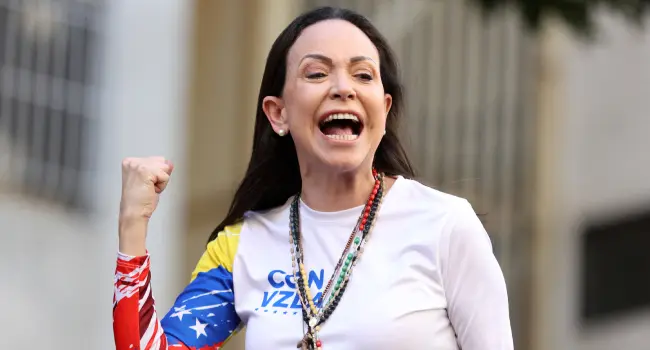
On Friday, Venezuela’s opposition leader and democracy activist Maria Corina Machado was awarded the Nobel Peace Prize, hailed by the Nobel Committee as a “unifying” force in a nation now described as a “brutal” authoritarian state.
Machado, who has been living in hiding for the past year, was honoured “for her tireless work promoting democratic rights for the people of Venezuela and her struggle to achieve a just and peaceful transition from dictatorship to democracy,” said Jorgen Watne Frydnes, chair of the Norwegian Nobel Committee, during the announcement in Oslo.
“I am in shock,” the 58-year-old opposition figure said in a video message shared by her press team.
The committee praised Machado as “one of the most extraordinary examples of civilian courage in Latin America in recent times.” Despite facing serious threats to her life, she has chosen to remain in Venezuela, inspiring millions with her bravery. Rumours have circulated that she is currently sheltering at the US embassy.
Venezuelan opposition figurehead Edmundo Gonzalez Urrutia described her award as “a well-deserved recognition of the long struggle of a woman and an entire people for freedom and democracy.”
Rising star of Venezuela’s opposition
Machado was the opposition’s presidential candidate for the 2024 elections, but the government of Nicolás Maduro blocked her candidacy. She then endorsed the little-known former diplomat Gonzalez Urrutia as her stand-in and actively campaigned alongside him.
Known for always wearing white, Machado has a rock star-like popularity among supporters, who flock to see her at rallies, offering handwritten notes, flowers, and baseball caps.
An engineer by training, Caracas-born Machado entered politics in 2002 leading the organization Sumate (Join Us), advocating for a referendum to recall Maduro’s predecessor, the late Hugo Chávez. She was accused of treason over the referendum, faced death threats, and sent her three children abroad for safety.
Machado’s rise had largely flown under the radar ahead of the Nobel announcement, despite winning prestigious accolades earlier in 2024, including the European Union’s Sakharov Prize for human rights and the Council of Europe’s Vaclav Havel Prize.
Her Nobel Prize arrives amid growing US military pressure off Venezuelan shores, aimed at Maduro’s regime, which Washington accuses of drug trafficking and refuses to recognize as legitimate.
Both Machado and Gonzalez Urrutia have endorsed US military pressure as a “necessary measure” to restore Venezuelan sovereignty.
Venezuela has transformed from a relatively democratic and prosperous country into a “brutal authoritarian state suffering a humanitarian and economic crisis,” said Frydnes. The opposition has faced systemic suppression through election rigging, legal prosecutions, and imprisonment.

Machado has been a “key, unifying figure” in a once deeply divided opposition movement.
Meanwhile, US President Donald Trump had openly campaigned for the Peace Prize, claiming credit for resolving global conflicts since his second term began in January — claims critics consider overstated.
The committee’s decision, made days before a ceasefire deal in Gaza was announced, underscores that it is not influenced by political lobbying or media campaigns. Frydnes emphasized, “We base our decision only on the work and the will of Alfred Nobel.”
The Nobel Peace Prize comes with a gold medal, a diploma, and a cash award of $1.2 million. The formal ceremony will take place in Oslo on December 10, the anniversary of Alfred Nobel’s death.
AFP