

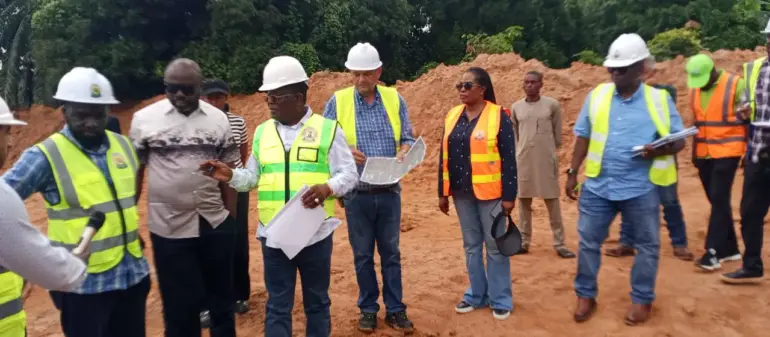
The Minister of Works, Senator David Umahi, has dismissed allegations that the Federal Government is concentrating road infrastructure projects in the South-East, saying all ongoing projects across the country are being executed in line with approvals granted by President Bola Tinubu.
Umahi made the clarification during an inspection tour of the strategic Trans-Sahara Highway project, where he stressed that federal road interventions were being implemented nationwide based on developmental needs rather than regional considerations.
The Trans-Sahara Highway corridor originates from Afikpo in Ebonyi State, passes through Ador in Benue State and Nsukka in Enugu State, traverses parts of Kogi State, and terminates at the Owete Bridge linking the route to the Federal Capital Territory.
To accelerate construction, the minister directed the contractor handling the project to commence simultaneous work on three designated sections. He also pledged to personally cross the Ador Bridge during his next inspection of the project.
Addressing allegations of regional bias, Umahi described claims circulating on social media as baseless and said official records of ongoing federal road projects were available to the public.
“They want to gag me on social media when they say I cornered all the road projects to the South-East,” Umahi said.
“That is very wonderful. But we have publications of all ongoing projects. So, I am not acting on my own; the President is my boss. Where would he be while I supposedly corner all the projects to the South-East?”
The minister acknowledged that the South-East, like other geopolitical zones, requires significant infrastructure investment but rejected claims that the region was receiving preferential treatment at the expense of other parts of the country.
“Some people are simply dissatisfied that, for the first time, the people of the South-East are receiving their fair share of our national infrastructure,” he said.
“I have always maintained that in terms of infrastructure development, the South-East may not rank first, second, or third, but they will definitely not be the last.”
Umahi defends government borrowing
Umahi also defended the Federal Government’s approach to borrowing for infrastructure development, arguing that targeted borrowing for productive projects can be economically justified when the funds are invested in projects capable of generating long-term economic benefits.
Reflecting on his tenure as governor of Ebonyi State, Umahi cited the construction of the 199-kilometre Ebonyi State Ring Road, which he said was financed through a $150 million facility.
“We borrowed because we knew precisely how to deploy the funds productively,” Umahi said.
“When people lack a clear developmental vision, they resort to saving money while critical needs persist, expecting public applause. What kind of economics is that? I do not believe in saving money or hoarding food when the people are hungry.”
He argued that delaying critical infrastructure projects could significantly increase construction costs over time, making timely investment more economically efficient.
70% foreign financing for legacy projects
Providing details of the Tinubu administration’s financing model for major infrastructure projects, Umahi said the government was using a combination of domestic and foreign financing.
“All four legacy projects, for example, have received 30 percent direct Naira funding from the Federal Government, with the remaining 70 percent secured through foreign financing structures,” he said.
The minister also rejected claims that the Ministry of Works had abandoned existing highways in favour of constructing new routes.
“When critics claim we have abandoned existing roads to construct new ones, that is completely untrue,” Umahi said. “Our route today utilised existing roads that were strategically expanded and rehabilitated.”
Umahi urged Nigerians, particularly residents of the South-East, to continue supporting the administration’s economic and infrastructure programmes, saying sustained investment was necessary to complete major capital projects across the country.
He also pointed to Nigeria’s foreign exchange reserves, which he put at approximately $55 billion, as an indication of the country’s financial position in supporting ongoing development projects.
