

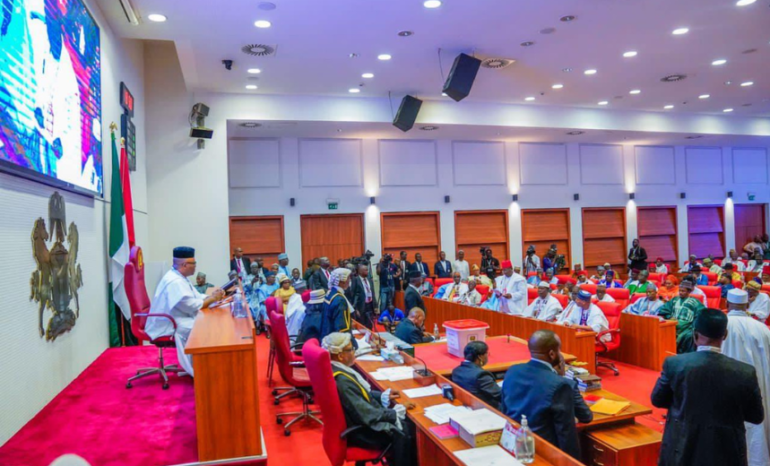
The Senate has passed a bill seeking to amend the 1999 Constitution to establish state police services across Nigeria, marking a major step in efforts to decentralise the country’s policing system and strengthen internal security.
The proposed legislation replaces the current single policing framework with a dual structure comprising a Federal Police Service and State Police Services.
The bill was passed after Senate Leader Opeyemi Bamidele presented its general principles. It subsequently scaled second reading, underwent clause-by-clause consideration, and passed third reading with the support of more than two-thirds of senators.
A key provision empowers state governors to appoint Commissioners of Police for their respective states, subject to confirmation by the state Houses of Assembly and the recommendation of the National Police Council.
Under Clause 17 of the proposed amendment, each State Police Service will be headed by a Commissioner of Police appointed by the governor, provided the nominee meets national minimum standards prescribed by an Act of the National Assembly.
The bill also defines the relationship between governors and state police commands. It allows governors to issue lawful written directives of a general policy nature to state police commissioners on matters relating to public safety and public order within their states.
To address concerns about potential abuse of state police by political officeholders, lawmakers included safeguards aimed at protecting civil liberties and political freedoms.
One provision expressly prohibits state police commissioners from arresting, detaining, investigating or deploying force against any individual, political party or group solely for criticising the government, except in accordance with the law.
The measure is intended to prevent the use of state police against political opponents, journalists, activists and other dissenting voices while ensuring compliance with due process.
The bill also grants the Federal Police Service limited powers to intervene in the security affairs of a state under specific circumstances, including situations where public order has broken down and the state police are unable or unwilling to contain the threat, or where a governor formally requests federal assistance.
Such interventions must be authorised in writing by the President and must clearly state the grounds, territorial scope, functions and duration of the intervention. The President is also required to notify the governor, the state House of Assembly, the National Police Council and the National Assembly within 48 hours.
Any federal intervention exceeding the period prescribed by law must receive Senate approval.
The Senate’s approval comes a day after President Bola Tinubu transmitted the bill to the National Assembly as part of broader efforts to reform Nigeria’s security architecture.

According to the President, the amendment will provide the legal framework for states to establish and operate their own police services alongside the federal police, while enabling communities, municipalities and local governments to play more active roles in maintaining security.
The proposal represents one of the most significant policing reforms since Nigeria’s return to democratic rule in 1999.
Advocates argue that state police would improve intelligence gathering, strengthen community-based policing and enable quicker responses to crime and security threats.
However, critics have raised concerns about possible political interference by governors, funding challenges and the potential for abuse of policing powers.
The renewed push for state police comes amid persistent insecurity, banditry, terrorism and kidnapping across several parts of the country, which have intensified calls for a more decentralised and responsive policing system.
