

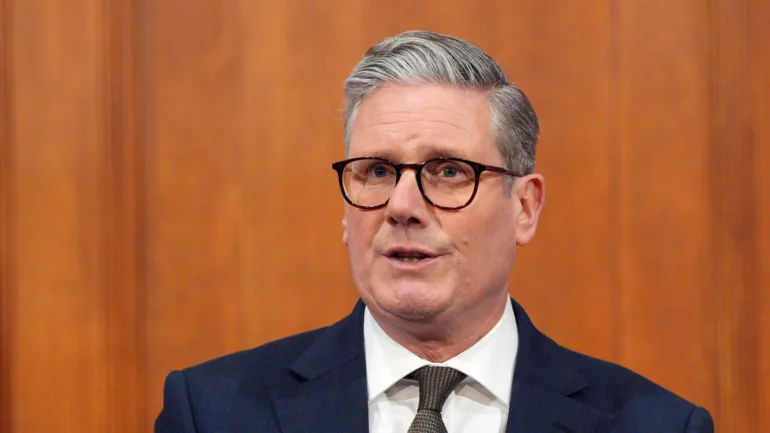
Keir Starmer has announced his resignation as British Prime Minister and leader of the Labour Party, bringing an end to months of political turmoil and triggering a leadership contest to choose his successor.
The announcement follows growing pressure on Starmer after Labour suffered significant losses in May’s local elections and faced an increasingly vocal revolt from within its own parliamentary ranks over his leadership and policy direction.
The move comes less than two years after Starmer led Labour to a landslide victory in the 2024 general election, securing one of the party’s largest parliamentary majorities in modern history.
Speaking outside 10 Downing Street shortly after 9:30 a.m. in London on Monday, Starmer said he would remain in office until the leadership contest is concluded to ensure an orderly transition of power.
He said every decision he had made as prime minister was guided by a commitment to “putting the country I love first.” Starmer also paid tribute to his wife, Victoria, describing her as his “rock,” and said he now hopes to be “the best dad I can be” to his children, whom he called his “pride and joy.”
Attention is now turning to veteran Labour politician Andy Burnham, who recently secured victory in a crucial by-election and is widely expected to launch a bid for the party leadership. Under Labour rules, the party leader must be a sitting Member of Parliament.
Starmer’s departure means Britain is set to have its seventh prime minister in just over a decade, highlighting an unprecedented period of political turnover in modern British history.
The 63-year-old former lawyer had repeatedly insisted he would resist any attempt to force him from office. However, the scale of Burnham’s victory in last week’s Makerfield by-election appears to have intensified pressure on the prime minister and prompted a reassessment of his position.
Even US President Donald Trump weighed in on the speculation, writing on his Truth Social platform on Sunday that “Keir Starmer will resign.” Trump, whose relationship with Starmer reportedly deteriorated amid disagreements over the Iran conflict, criticised the British leader’s record on immigration and energy policy before adding: “I wish him well.”
Burnham, who has served as Mayor of Greater Manchester since 2017, has made little secret of his leadership ambitions. In his by-election victory speech, he warned that Labour faced a “final chance to change” course.
Growing pressure
According to reports, Starmer spent the weekend with his family at Chequers, the prime minister’s country residence, consulting with close allies as pressure mounted.
Business Secretary Peter Kyle told Sky News that Starmer was “making time to reflect on the political realities, challenges and opportunities” facing his government.

Before the resignation announcement, reports suggested that Starmer and his inner circle had already begun preparing for a leadership transition, with discussions centred on a timetable that could have seen him remain in office until after the summer.
Several senior Labour figures were reportedly urging him to step aside. Sky News reported that Foreign Secretary Yvette Cooper was among cabinet members encouraging his departure, while more than 100 Labour MPs were said to have called for his resignation.
Starmer, who entered Downing Street in July 2024, had faced mounting criticism throughout his tenure over policy reversals, political controversies, ministerial resignations and a series of governance challenges.
His authority was further weakened earlier this year by controversy surrounding the appointment of Peter Mandelson as the UK ambassador to Washington, a decision that sparked widespread criticism within Labour and beyond.