

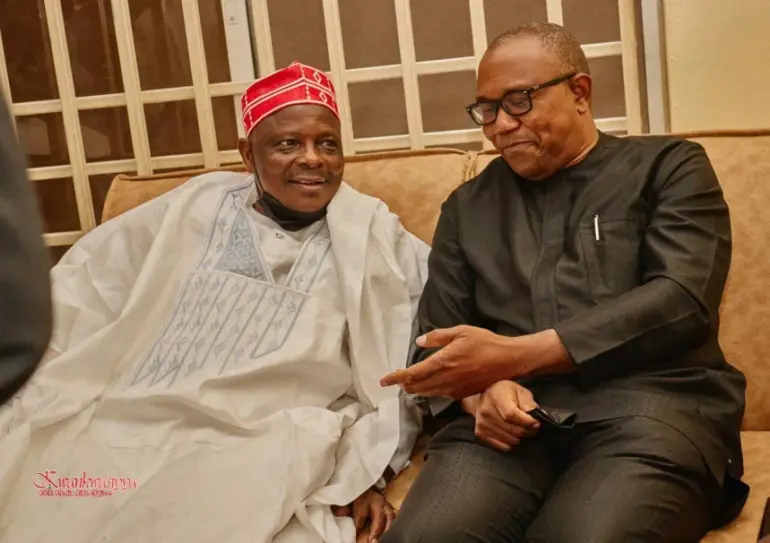
The Nigeria Democratic Congress has intensified political manoeuvring ahead of the 2027 general elections, making a fresh push to bring opposition figures Peter Obi and Rabiu Musa Kwankwaso onto a joint presidential ticket under its platform.
In a post on X, the party hinted at an urgent window for political realignment, stating: “All we need right now; just all we need. Two weeks to deadline,” alongside an image of both politicians shaking hands with the caption, “Nigeria will be OK.”
The message has fuelled speculation over a potential opposition coalition, as realignments gather pace ahead of the next electoral cycle.
Supporters of Obi and Kwankwaso have also reportedly launched a joint mobilisation effort, dubbed the “OK Movement,” aimed at promoting a possible alliance for the 2027 presidential race. The initiative is said to be expanding across several states, further raising expectations of a broader opposition front.
INEC recognises SDP leadership
Meanwhile, the Independent National Electoral Commission has recognised the National Working Committee of the Social Democratic Party led by Shehu Gabam.
The development follows a ruling by the Court of Appeal in Abuja affirming Gabam as the party’s authentic National Chairman.
INEC, in an update on its official website, listed Gabam as National Chairman and Olu Agunloye as National Secretary, with several entries marked “By Court Order.”
The electoral body has also set May 30, 2026, as the deadline for political parties to submit membership registers and conclude candidate nominations for the 2027 elections.
Adebayo criticises INEC
The decision drew criticism from former SDP presidential candidate Adewole Adebayo, who accused INEC of actions that could undermine public confidence in the electoral process.
Reacting to the removal of Prof. Sadiq Gombe’s name from the commission’s website and its replacement with Gabam’s, Adebayo described the move as troubling and politically significant.
He alleged that the development reinforces perceptions of external influence over the electoral body.
“These kinds of inconsistencies only deepen an already troubling perception—that decisions may not be entirely institutional,” he said.
Adebayo further argued that administrative updates on INEC’s website do not necessarily resolve underlying disputes over party leadership.
Opposition uncertainty persists
The developments come amid ongoing uncertainty within opposition parties. The African Democratic Congress remains embroiled in leadership disputes, with a related case still pending before the Supreme Court.
With coalition talks intensifying and internal party conflicts unresolved, Nigeria’s opposition landscape continues to evolve ahead of the 2027 general elections.
