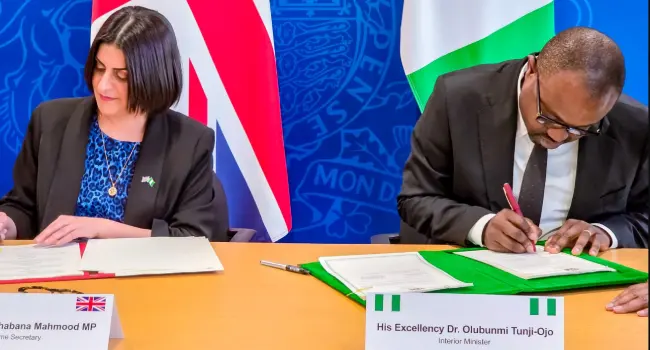
Nigeria and the United Kingdom have signed a new agreement aimed at “speeding up” the return of Nigerian nationals with no legal right to remain in the UK, including visa overstayers, failed asylum seekers, and individuals classified by the British government as “foreign offenders.”
The deal was reached during President Bola Ahmed Tinubu’s two-day state visit to the UK, reflecting a mutual commitment to strengthen cooperation on migration management and border control.
The agreement was finalised between UK Home Secretary Shabana Mahmood and Nigeria’s Minister of Interior, Olubunmi Tunji-Ojo.
Under the new arrangement, the UK will, for the first time, be able to return affected individuals using “UK letters”, alternative identification documents issued to people without valid passports, after the Nigerian government agreed to recognise them. According to the Home Office, this removes a major administrative hurdle, as the UK will no longer have to wait for emergency travel documents to be issued by Nigeria.
“Visa overstayers, foreign criminals, and failed asylum seekers will now be removed from British soil far more efficiently,” the Home Office said.
UK Minister for Border Security and Asylum Alex Norris added, “Anyone who abuses our systems, breaks our laws, or tries to cheat their way into Britain will be stopped and removed. Today’s agreement is another step in restoring order at the border by ensuring those with no right to remain are swiftly returned.”
Nigeria’s commitment
Tunji-Ojo reaffirmed Nigeria’s commitment to responsible migration practices, describing the agreement as a reflection of the country’s willingness to meet international obligations.
“For us, as a country, we are committed to being responsible in fulfilling our core obligations. This partnership with the UK is important, and President Tinubu has shown great dedication to strengthening it. We aim to sustain this relationship for generations,” Tunji-Ojo said.
Wider migration and security reforms
The Home Office explained that the agreement forms part of broader reforms to tighten UK immigration controls. Annual returns to Nigeria have nearly doubled to 1,150, while overall deportations and removals from the UK have reached nearly 60,000 since the 2024 general election.
Both countries also agreed to deepen collaboration on immigration-related crimes, including fake job sponsorships, sham marriages, and forged financial or employment records. Nigeria will review its laws to ensure tougher penalties for offenders.
The agreement additionally addresses the protection of Nigerian women and children at risk of exploitation and aims to improve business visa schemes to support UK-Nigerian trade and investment. Other areas of collaboration include tackling financial and cyber crimes, such as romance fraud, investment scams, and cryptocurrency offences.

State visit highlights
During his state visit, President Tinubu held bilateral talks with UK Prime Minister Keir Starmer at Downing Street, where the two countries agreed on a £746 million deal to refurbish two major ports in Lagos.
Describing the visit as “thrilling and significant,” Tinubu said it marked a new chapter in strengthening Nigeria-UK relations. Discussions also covered trade, the economy, climate change, terrorism, and other global challenges.
At Windsor Castle, Tinubu and First Lady Oluremi Tinubu were received by King Charles III and Queen Camilla, where he highlighted the enduring relationship between both nations.
“Our two nations share a vision of progress and resilience. We continue that journey, committed to building a future rooted in partnership, mutual respect, and common values,” he said.
The state visit, the first by a Nigerian leader to the UK in 37 years, also included engagements with the Nigerian diaspora, business leaders, and the signing of agreements covering trade, investment, defence, cultural cooperation, and energy transition.