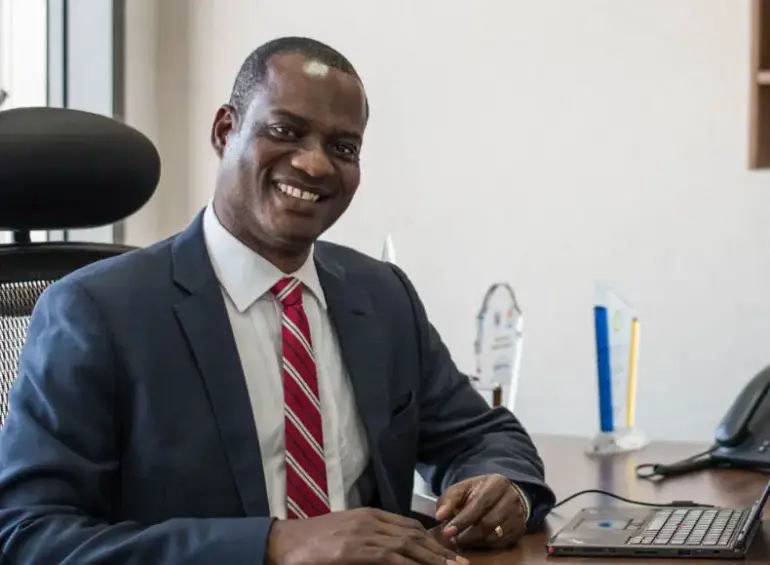
The Senate on Wednesday confirmed the appointment of Taiwo Oyedele as Minister of State for Finance after nearly three hours of questioning by lawmakers on economic and fiscal issues.
During the screening, Oyedele outlined strategies aimed at stabilising government revenue, improving contractor payments and expanding Nigeria’s revenue sources beyond crude oil.
Addressing Nigeria’s heavy reliance on oil revenue, Oyedele suggested that forward sales of crude could help shield the economy from price volatility while ensuring more predictable fuel pricing.
“One strategy used in several countries is selling crude forward. Nigeria can lock in a price for a portion of our crude for a period of time. That would guarantee budget financing and also give Nigerians stability so prices are not fluctuating the way we have seen in recent days,” he said.
On the persistent challenge of delayed contractor payments, Oyedele proposed that government contracts should only be awarded based on available funds. According to him, delayed payments often lead to a “trust deficit premium,” where a contract initially valued at ₦1 billion could rise to ₦2 billion due to payment delays.
He also stressed the need for Nigeria to explore other sources of revenue outside oil and taxation.
“For many years as a country, we have disproportionately focused on taxation and oil and gas, and that has taken our attention away from other areas where we can generate revenue,” he said.
Highlighting the potential of the solid minerals sector, Oyedele noted that policy uncertainty remains a major barrier to growth.
“What we have identified as the biggest impediment to the growth of the solid minerals sector is policy uncertainty. The team and the Minister of Solid Minerals have been doing a lot, but we need to complement that with a policy certainty environment. We may be coming to the National Assembly in this regard,” he added.
The nominee also emphasised the importance of realistic budgeting and full implementation of approved projects.
“When we have budgets, we need to ensure that there is funding behind them and that there are releases so that we can execute them, 100 per cent if possible, particularly for capital expenditure,” he said.
Oyedele noted that many of Nigeria’s budgets in recent years appeared overly ambitious compared with actual revenue.
“Looking at Nigeria’s budgets over the past five years, many appeared too ambitious relative to revenue. We focused on expenditure without paying enough attention to the revenue side,” he said.
He added that nearly half of the budgets of both federal and state governments are currently deficit-financed.
“Today, if you combine the federal and state governments, nearly half of our budgets are deficit-financed. We need to pay more attention to realistic revenue to drive our projects,” he said.
Outlining his priorities in office, Oyedele said he would begin with a clear assessment of government financial obligations.
“If I am confirmed by this distinguished Senate, one of the first things I will do is create a clear status quo analysis. If we owe contractors, we should know it,” he said.

“We should say: as of today, this is how much we owe contractors, this is how much we have, this is the gap, and this is how we plan to raise the money.”
On government spending and inflation, Oyedele noted that increased revenue from subsidy removal represents a transfer of resources from citizens to government.
“If the government gets more revenue because subsidies have been removed, it is actually a transfer from the people to the government,” he said.
“The only way we can make that sacrifice worthwhile is to spend that money in areas of priority for the people.”
He also stressed that targeted infrastructure investments linking farms to markets could deliver quick economic benefits.
“Those priorities can be as basic as roads from the farm to the warehouse, to the factory, and to the markets. When that happens, people see the impact almost immediately,” he said.
Following his confirmation, Senate President Godswill Akpabio commended President Bola Tinubu for appointing what he described as “a square peg in a round hole.”
Akpabio also praised Oyedele’s expertise and suitability for the role.