President Donald Trump threatened to intensify bombing of Iran on Saturday, as Iranian President Masoud Pezeshkian vowed the country would never surrender, following a fresh wave of US and Israeli air strikes that set Tehran’s Mehrabad International Airport ablaze.
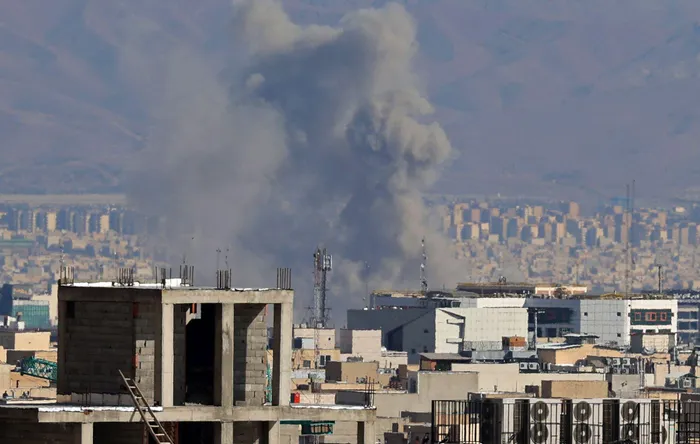
Israel confirmed some of its heaviest raids since the campaign began last Saturday, targeting a military academy, an underground command centre, and a missile storage facility. Pre-dawn AFP photos showed fire and smoke rising from one of Tehran’s two main airports.
“Today Iran will be hit very hard!” Trump posted on Truth Social. “Under serious consideration for complete destruction and certain death, because of Iran’s bad behavior, are areas and groups of people that were not considered for targeting up until this moment in time.”
In a televised address, Pezeshkian struck a defiant tone in response to Trump’s Friday demand for “unconditional surrender.” “Iran’s enemies must take their wish for the unconditional surrender of the Iranian people to their graves,” he said.
Despite relentless attacks on its military infrastructure, Iran demonstrated it retains missile and drone capabilities. Air raid alerts and explosions were reported over Jerusalem, Dubai, Manama, and near Riyadh, where Saudi Arabia intercepted a ballistic missile aimed at a US air base. The UAE said it intercepted 15 ballistic missiles and 119 drones, though video showed one projectile hitting Dubai airport.
Jordan accused Iran of targeting “vital installations” with 119 missiles and drones over the past week. Pezeshkian apologised to Gulf neighbours hosting US bases, warning they would only be targeted if used for attacks. Iran’s Revolutionary Guards also reported firing on the oil tanker Prima in the Gulf, crossing the Strait of Hormuz, a key chokepoint for global shipping.
Human cost
The conflict, now in its second week, began with joint US-Israeli airstrikes that killed Iranian supreme leader Ali Khamenei. It has since spread to Lebanon, Cyprus, Turkey, Azerbaijan, and as far as Sri Lankan waters, where US forces sank an Iranian warship.
Inside Iran, damage to infrastructure and residential buildings is mounting. Residents in Tehran report anxiety and a heavy security presence. “I don’t think anyone who hasn’t experienced war would understand it,” a 26-year-old teacher told AFP. “When you hear the bombs, you have no idea where they will hit.”
Iranian health authorities reported 926 civilian deaths and around 6,000 injuries, though AFP could not independently verify these figures. In Lebanon, Israeli air strikes killed at least 217 people, with Prime Minister Nawaf Salam warning of a “humanitarian disaster.” Israeli Defence Minister Israel Katz threatened Lebanon with a “very heavy price” if it fails to disarm Hezbollah.
The conflict is also hitting global markets, with stock prices falling and crude oil surging. Analysts warn there is no clear path to ending a war US and Israeli officials suggest could last a month or more.
Defiance and diplomacy
Trump has rejected fresh talks with Tehran, reiterating that “there will be no deal with Iran except UNCONDITIONAL SURRENDER,” and promising to help rebuild Iran’s economy if an “acceptable” successor to Khamenei is installed.
Iranian UN ambassador Amir Saeid Iravani dismissed this, saying the country’s leadership succession “will take place strictly in accordance with our constitutional procedures and solely by the will of the Iranian people, without any foreign interference.”
Fresh strikes on March 6 targeted Iran and Lebanon as Israel vowed to escalate the conflict further. Meanwhile, US rivals China and Russia have largely stayed out of the fighting. Russian President Vladimir Putin called for an “immediate” ceasefire in a phone call with Pezeshkian, while US Defense Secretary Pete Hegseth said the US is “not concerned” by reports Russia may be providing Iran with intelligence.
The war has killed six US service members, whose bodies Trump is set to receive at Dover Air Force Base in Delaware on Saturday.
AFP