
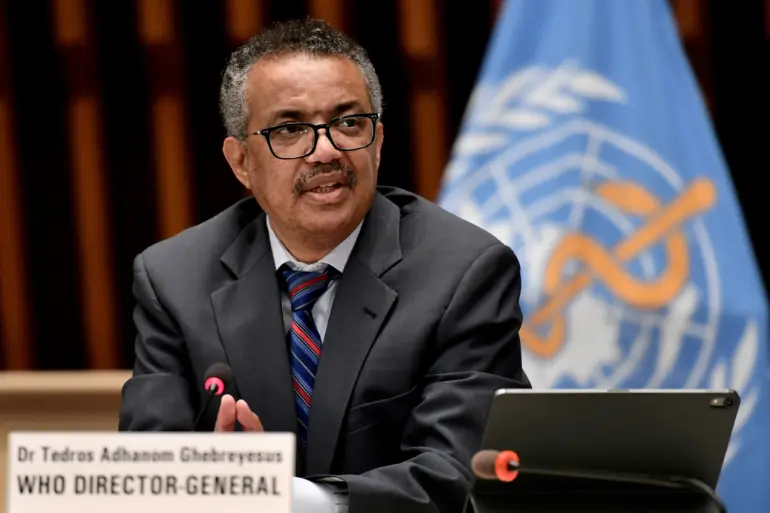
The Middle East war has forced the World Health Organization (WHO) to suspend operations at its global emergency logistics hub in Dubai, the UN agency’s chief said Thursday.
WHO Director-General Tedros Adhanom Ghebreyesus warned the impact of the conflict triggered by US-Israeli attacks on Iran on Saturday “goes beyond the immediately affected countries.”
“Operations at WHO’s logistics hub for global health emergencies in Dubai are currently on hold due to insecurity,” he told a press conference.
Last year, the hub processed more than 500 emergency orders for 75 countries worldwide, according to Hanan Balkhy, WHO’s Eastern Mediterranean regional director.
She warned that humanitarian health supply chains were now under threat.
“The hub’s operations are temporarily on hold due to insecurity, airspace closures and restrictions affecting access to the Strait of Hormuz,” Balkhy said.
The disruption is blocking access to $18 million worth of humanitarian health supplies, while another $8 million in shipments cannot reach the hub.
More than 50 emergency supply requests from 25 countries have been affected, along with about $6 million in medicines destined for the war-torn Gaza Strip.
‘Extremely important lifeline’
An additional $1.6 million in polio laboratory supplies are also being held up, a delay Balkhy said could have serious consequences for Afghanistan and Pakistan, where the disease remains endemic.
WHO is coordinating with authorities in the United Arab Emirates on how to resume operations at the hub.
The agency is also discussing alternative supply routes with humanitarian partners through other logistics centres in Nairobi, Dakar and Brindisi.
If the conflict drags on, Balkhy said the WHO may need to explore potential land routes, possibly through Saudi Arabia, though she expressed hope that would not be necessary.
“The Dubai hub is an extremely important lifeline for the humanitarian response,” she said.
‘Nuclear risks’
Balkhy said the WHO is coordinating the health response across 16 affected countries and supporting health ministries and partners to maintain essential services.
The agency is also strengthening disease surveillance and preparing for potential mass casualties and displacement.
Iran has not yet made a formal request for specific supplies, Balkhy said, adding that the country’s health system is currently coping with the situation.

However, the WHO is “scaling readiness for chemical, biological, radiological and nuclear risks”.
Tedros also warned about threats to nuclear facilities amid the conflict.
“Any compromise to nuclear safety could have serious public health consequences,” he said.
The WHO further sounded the alarm over attacks on healthcare facilities.
The organisation has verified 13 attacks on healthcare in Iran since the conflict began, killing four people and injuring 25. In Lebanon, an attack killed three paramedics and injured six others.
“Under international humanitarian law, health care must be protected and not attacked,” Tedros said.
AFP
