
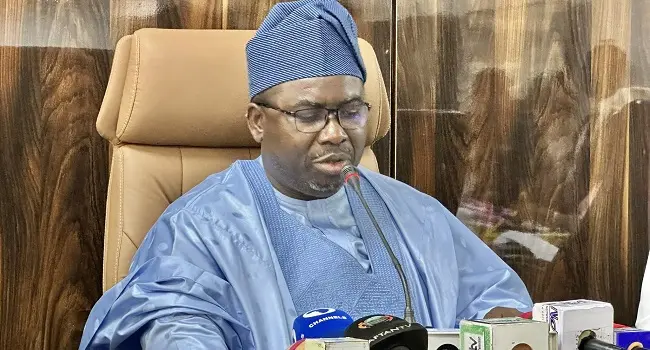
The Chairman of the Independent National Electoral Commission (INEC), Prof. Joash Amupitan, has assured Nigerians that the commission is capable of electronically transmitting election results in 2027. However, he cautioned that a “100 per cent perfect election” cannot be guaranteed.
Amupitan spoke on Sunday during the Citizens’ Town Hall programme, aired live on Channels Television, themed “Electoral Act 2026: What it means for your votes and the 2027 elections.”
He urged citizens to temper expectations, stressing that while INEC will strive for excellence, perfection remains unrealistic.
“Let me appeal to Nigerians. I’ve noticed that what people desire is a perfect election. INEC will strive to give the country the best election possible. However, we may not achieve a 100 per cent perfect election for now. Regarding electronic transmission of results, we have the capacity and we will transmit results. The main challenge is real-time transmission,” he said.
Amupitan described elections as the cornerstone of democracy and highlighted the importance of voter education and transparency.
“Elections are the lifeblood of democracy. As Abraham Lincoln said, the ballot is more powerful than the bullet. Voter ignorance undermines national security. That is why INEC and civil society play a crucial role in ensuring transparent and credible elections,” he stated.
He revealed that INEC actively contributed to shaping the Electoral Act 2026, a process that began three years ago with a joint committee of the National Assembly, civil society organisations, and the commission.
“When I took over, most of the work was almost concluded, but we made important provisions and recommendations in the new Act,” he said.
Addressing the debate over electronic transmission, which gained prominence after the 2023 general elections, Amupitan said INEC advocated for mandatory transmission during legislative discussions.
“The original provision from the National Assembly retreat was not exactly what we have today. INEC advocated for mandatory transmission, but the challenge remains defining ‘real time,’” he explained.
Using the recent Federal Capital Territory (FCT) Area Council elections as an example, he illustrated challenges in real-time transmission, particularly in remote areas.
“In the FCT, results from five of six councils were timely. But in Kuje’s Kabi ward, results were delayed until the following day due to difficult terrain and inaccessibility. Security and polling officials had to be physically sent to ensure safety before results could be collected,” he recounted.
Despite delays, Amupitan said transmission itself was not the main issue; network adequacy and logistics were critical.

“Transmission is not the problem. The main challenge is network adequacy and logistics. For example, in the FCT, real-time transmission from Kabi ward was impossible due to terrain and connectivity issues,” he said.
He emphasised that logistics are essential for election credibility.
“An election is only as good as its logistics. Failures in this area undermine public trust. While the FCT poll faced some logistical issues, including human errors, corrective measures are underway,” he added.
Looking ahead, Amupitan expressed optimism for the 2027 general elections, citing increased voter awareness and a stronger demand for accountability.
“The 2027 elections will be the best Nigerians have seen. People are more aware, and a transparent election builds trust in INEC and leaders, which is essential for national development,” he concluded.
