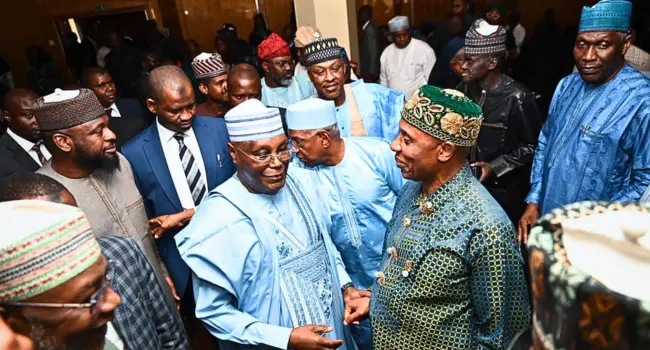
Leaders of the opposition African Democratic Congress (ADC) and New Nigeria Peoples Party (NNPP) on Thursday intensified pressure on the National Assembly, demanding an immediate amendment of the Electoral Act 2026, which they described as anti-democratic and skewed ahead of the 2027 general elections.
However, the Senate dismissed the agitation, urging opposition figures including Atiku Abubakar, Peter Obi, and Rotimi Amaechi to channel their concerns through the appropriate legislative process.
Addressing a press conference in Abuja, NNPP National Chairman, Ajuji Ahmed, called for the immediate removal of what he termed “obnoxious provisions” in the newly signed law.
Under the previous Electoral Act 2022, political parties could nominate candidates through direct primaries (involving all registered members), indirect primaries (via delegates), or consensus arrangements.
But the Electoral Act 2026, recently passed by the National Assembly and assented to by President Bola Tinubu on February 18, restricts parties to only direct primaries and consensus options. It also shortens campaign timelines and reduces the period for releasing funds to the Independent National Electoral Commission from 12 months to six months before elections.
Ahmed alleged that the new provisions were designed to undermine electoral transparency ahead of 2027, particularly citing Section 60(3), which grants discretionary powers to presiding officers in the transmission of election results.
He argued that the justification of “network failure” was inconsistent with previous assurances by former INEC Chairman, Prof. Mahmud Yakubu, and former INEC Commissioner, Festus Okoye, who had maintained that result transmission systems function largely offline and have high success rates.
The opposition also faulted the amendment to Section 84, which limits parties to direct primaries and consensus, describing it as an infringement on the constitutional autonomy of political parties.
“We do not need legislation that prescribes which mode of primaries political parties must adopt. That is strictly an internal affair,” Ahmed said, warning that failure to amend the law could undermine public confidence in the 2027 elections.
Judiciary and governance concerns
Opposition leaders further expressed concern about what they described as the “weaponisation” of the judiciary in recent electoral disputes, urging judicial officers to remain impartial and safeguard democratic principles.
Amaechi, a former presidential aspirant of the ruling party, said the opposition must focus on strategy rather than blame President Tinubu alone.
“Tinubu is not our problem; the opposition is the problem of the opposition,” he said, urging stronger internal coordination ahead of 2027.
Peter Obi lamented worsening economic conditions, rising poverty, insecurity, and what he described as excessive borrowing without corresponding development outcomes.

Former Vice-President Atiku Abubakar warned that democratic backsliding in Nigeria could have ripple effects across Africa, calling for broader unity among opposition parties.
Senate pushes back
Reacting, Senate spokesman Yemi Adaramodu advised opposition leaders to present formal proposals through lawmakers rather than escalate political tensions.
“If there are grey areas, they should bring proposals to their legislators. The National Assembly will consider them,” he said.
Similarly, Senator Orji Uzor Kalu stressed that the power to amend the Electoral Act rests solely with the legislature and cautioned against rhetoric that could destabilise the polity.
The exchange underscores rising political tensions as parties begin early manoeuvres ahead of the 2027 general elections, with opposition groups pressing for changes to the electoral framework while the Senate insists on strict adherence to constitutional procedures.