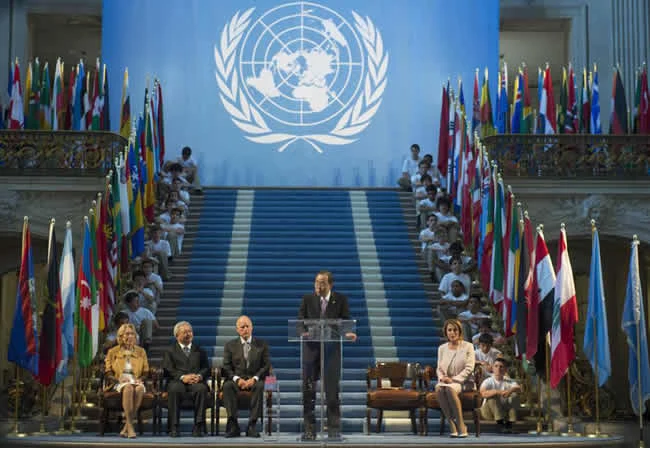
Nigeria joined 106 other member states of the UN General Assembly on Tuesday in backing Ukraine, marking four years since Russia launched its full-scale invasion on February 24, 2022.
Meeting in an emergency special session, the General Assembly adopted a resolution titled “Support for Lasting Peace in Ukraine” by 107 votes in favour, 12 against and 51 abstentions, among them the United States.
The resolution calls for a comprehensive, just and lasting peace, an immediate and unconditional ceasefire, the exchange of prisoners of war and the return of forcibly transferred civilians, including children. It also reaffirms the Assembly’s commitment to “the sovereignty, independence, unity and territorial integrity of Ukraine within its internationally recognised borders.”
President of the UN General Assembly, Annalena Baerbock, said Russia’s full-scale invasion had shattered Europe’s long-held sense of peace, warning that war must not become “the new normal.”
“Four years ago, people in Europe woke up in another world,” she said. “Generations like mine had always had the privilege of living in peace. That changed with Russia’s full invasion of its neighbouring country, Ukraine.”
UN Secretary-General António Guterres described the anniversary as a sombre milestone, noting that the invasion violated the UN Charter and international law.
“This devastating war is a stain on our collective conscience and remains a threat to regional and international peace and security,” Guterres said. “The longer the war continues, the deadlier it becomes.” He added that civilians continue to bear the brunt of the conflict, with 2025 recording the highest number of civilian casualties in Ukraine.
Guterres reiterated his call for an immediate, full and unconditional ceasefire as a first step towards a just and lasting peace, urging the international community to deploy every available diplomatic tool to end the war as it enters its fifth year.
Addressing the UN Security Council, Ukraine’s Deputy Foreign Minister, Mariana Betsa, described Russia’s invasion as a war against the rules-based international order. She cited mass strikes on civilians, nuclear risks and the deportation of children as potential war crimes.
Betsa stressed that peace must begin with an immediate ceasefire and called for stronger sanctions, enhanced air defence systems and binding security guarantees. She rejected any territorial concessions, describing Ukraine’s sovereignty as a “red line,” and urged continued prisoner exchanges and accountability, warning that if aggression prevails, “no country will feel safe.”
Russia’s delegate dismissed the meeting as unrelated to maintaining international peace and security, accusing European states of prolonging the conflict while neglecting negotiations. He alleged that the 2014 change of power in Kyiv installed a “neo-Nazi regime” and claimed crimes against Russian speakers had been ignored.
Moscow maintained that diplomacy remains preferable but insisted any settlement must address what it termed the conflict’s “root causes” and reflect “new territorial realities.”
NAN