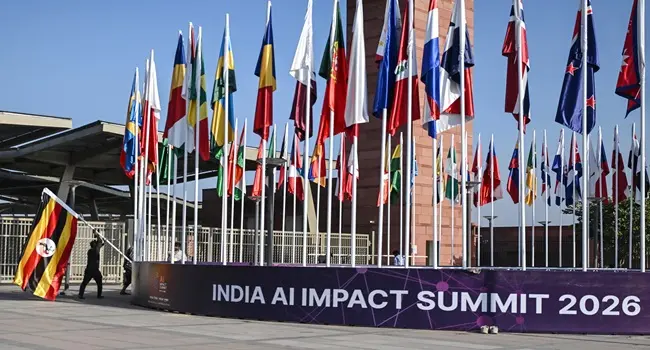
A major global artificial intelligence summit begins in New Delhi on Monday, tackling issues from job disruption to child safety, though some experts warn that the broad focus could dilute chances of concrete commitments from world leaders.
While surging demand for generative AI has driven profits for tech companies, concerns are rising about the technology’s societal and environmental risks.
Prime Minister Narendra Modi will inaugurate the five-day AI Impact Summit, which aims to establish a “shared roadmap for global AI governance and collaboration.”
“This occasion is further proof that our country is progressing rapidly in science and technology and shows the capability of our country’s youth,” Modi said in a post on X on Monday.
The event marks the fourth annual international gathering addressing AI opportunities and challenges, following previous meetings in Paris, Seoul, and Britain’s historic wartime code-breaking hub, Bletchley.
Touted as the largest edition yet, the Indian government expects 250,000 visitors from across the sector, including 20 national leaders and 45 ministerial delegations. Attending tech executives include Sam Altman and Sundar Pichai, though Nvidia CEO Jensen Huang has reportedly cancelled due to unforeseen circumstances.
Modi will meet leaders such as Emmanuel Macron and Luiz Inacio Lula da Silva to “strengthen global partnerships and define India’s leadership in the AI decade ahead,” according to summit organisers.
Yet whether leaders will hold AI companies accountable remains uncertain. “Industry commitments at past summits have largely been narrow self-regulatory frameworks that let AI firms grade their own homework,” said Amba Kak, a former US Federal Trade Commission AI adviser attending the summit.
AI safety in focus
The 2023 Bletchley gathering, held a year after ChatGPT’s breakthrough, was called the AI Safety Summit. Since then, the meetings have expanded in scope. At last year’s AI Action Summit in Paris, dozens of nations endorsed a statement urging regulation to make AI “open” and “ethical,” though the US did not sign, with Vice President JD Vance cautioning that excessive regulation could stifle a transformative sector.
This year, the Delhi summit is structured around three “sutras”: people, progress, and planet. AI safety remains a priority, including the growing threat of misinformation and deepfakes.

Last month, Elon Musk’s Grok AI faced backlash for enabling users to create sexualised images of real people, including children. “Child safety and digital harms are moving up the agenda, particularly as generative AI lowers the barrier to harmful content,” said Kelly Forbes. “There is real scope for change, though it may not happen fast enough.”
AI for ‘the many‘
Organisers emphasise that this is the first AI summit hosted by a developing country. “The summit will shape a shared vision for AI that truly serves the many, not just the few,” said India’s IT ministry.
India recently rose to third place globally in AI competitiveness, overtaking South Korea and Japan, according to Stanford University researchers. Despite ambitious infrastructure projects and innovation goals, experts note that India still lags behind the US and China in AI development.
Seth Hays, author of the Asia AI Policy Monitor newsletter, predicts summit discussions will focus on “ensuring governments implement guardrails without throttling AI development.” He added, “There may be announcements for increased state investment, but India will still need international partnerships to integrate fully into the global AI landscape.”