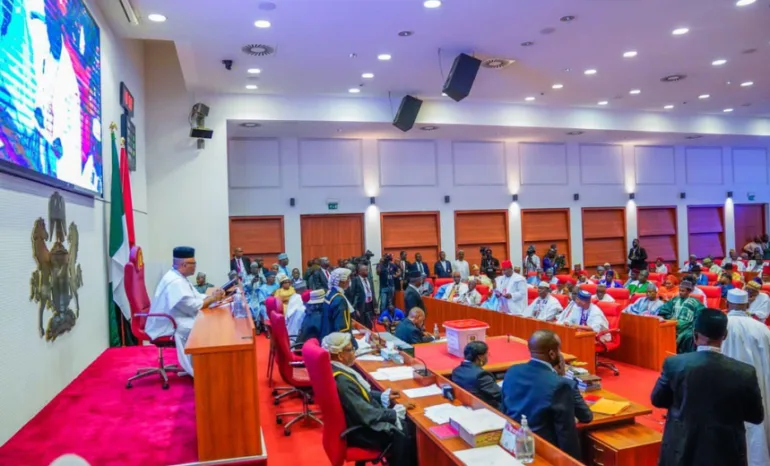
The Senate has explained that empirical data informed its decision to make the electronic transmission of election results discretionary, rather than mandatory, in the ongoing reform of Nigeria’s electoral governance framework.
Senate Leader, Senator Opeyemi Bamidele, clarified the position on Sunday through his media office, emphasizing that the decision was based on “the stark realities of the country” after consultations with key stakeholders in the communications and power sectors. He stressed that lawmaking must prioritize the citizenry over public sentiment.
Clause 60(3) of the Electoral Bill, 2026, initially required presiding officers to “electronically transmit results from each polling unit to INEC Result Viewing Portal (IReV) in real time.” The Senate reviewed the clause, retaining electronic transmission while adding a caveat that, in the event of Internet failure, Form EC8A would remain the primary means of result collation.
Bamidele acknowledged the potential of real-time electronic results to strengthen public trust in democratic institutions but noted infrastructural limitations. Citing data from the Nigerian Communications Commission, he said broadband coverage in Nigeria was only 70 percent in 2025, while Internet penetration stood at 44.53 percent.
He also referenced the Speedtest Global Index, which ranked Nigeria 85th out of 105 countries in mobile network reliability and 129th out of 150 in fixed broadband reliability. Nigeria’s mobile network speed was 44.14 Mbps compared to 691.76 Mbps in the UAE, while fixed broadband averaged 33.32 Mbps, far below global standards.
Power infrastructure was also cited as a limitation. Bamidele noted that 85 million Nigerians, about 43 percent of the population still lack access to grid electricity. While national generation capacity is roughly 12,000–13,500 megawatts, distribution constraints mean only 4,500 megawatts reach households. He added that the Electricity Act, 2025, is expected to improve the situation.
“Making real-time electronic transmission mandatory at this stage could plunge the country into a crisis,” Bamidele said. “By global standards, it may not be practicable given our current development level.” He argued that discretionary transmission, combined with safeguards in Section 62(2) of the Electoral Act, 2022, strikes a balance between technological progress and practical realities.

The Senate’s decision came amid nationwide debate, protests, and opposition criticism from figures such as former presidential candidate Peter Obi and former Rivers State Governor Rotimi Amaechi. An emergency Senate session was convened to address public concerns.
Bamidele concluded: “Law-making is the lifeblood of governance. It must respond to facts, proofs, and realities, not mere sentiment. This guided the Senate’s redrafting of Clause 60(3 & 5), with the deletion of ‘real time’ to ensure an electoral framework aligned with Nigeria’s infrastructural realities.”