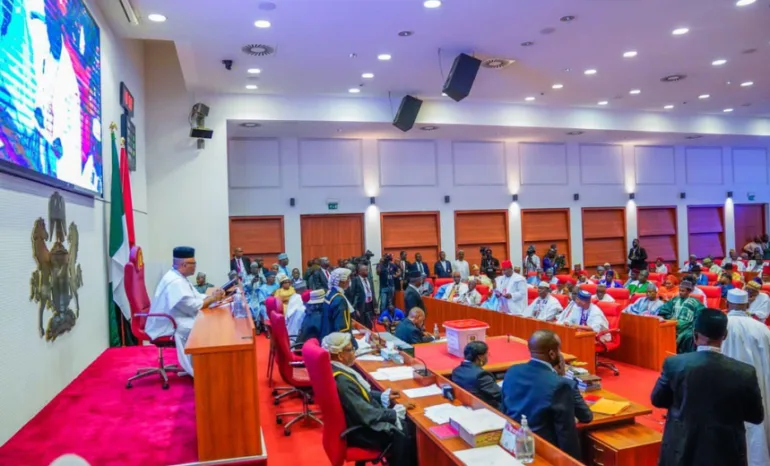
The Senate has constituted a seven-member committee to harmonise contributions and opinions on the Electoral Act Amendment Bill, 2026, with a mandate to present a consolidated report to the chamber next Tuesday.
The decision followed over two hours of consideration of the bill’s provisions during a closed-door session on Thursday.
The committee is chaired by Senator Niyi Adegbomore, Chairman of the Senate Committee on Judiciary, Human Rights, and Legal Matters. Other members are Senators Adamu Aliero, Aminu Tambuwal, Adams Oshiomhole, Danjuma Goje, Tony Nwoye, and Titus Zam.
The group has three days to complete its assignment and submit its report for consideration at the next plenary session.
On Thursday, the Senate began consideration of the Electoral Act 2022 (Repeal and Re-enactment) Bill 2026, moving into a closed-door session to review documents submitted by Senator Simon Lalong, Chairman of the Senate Committee on Electoral Matters.
The bill is designed to expand voter participation, safeguard against electoral fraud, and strengthen the institutional capacity of the Independent National Electoral Commission (INEC).
The closed session allowed lawmakers to thoroughly examine the proposed amendments and supporting documents before engaging in further legislative debate. This follows the upper chamber’s deferral of the bill on Wednesday to allow for detailed review.
Although the House of Representatives has already passed the bill, Senate President Godswill Akpabio emphasized the importance of careful scrutiny given its implications for the nation’s electoral process.
“This is a very important bill, especially as it is election time. We must take our time to ensure justice is done to all, so that we do not end up at the tribunal,” he said.

According to the committee, a clause-by-clause analysis indicates that enacting the legislation would leave Nigerians with a lasting legacy of electoral integrity, enhance transparency, and boost public confidence.
The bill contains more than 20 key innovations, including provisions recognising the voting rights of prisoners and mandating INEC to register eligible inmates in correctional facilities nationwide.
It prescribes sanctions for vote-buying, ranging from a fine of N5 million to a two-year jail term, as well as a 10-year ban from contesting elections. It also recommends stricter penalties for offences such as result falsification and obstruction of election officials.
Other provisions include standardising delegates for indirect party primaries to prevent arbitrary determinations by party leaders, and addressing INEC’s perennial funding challenges by mandating the release of election funds at least one year before polling day.