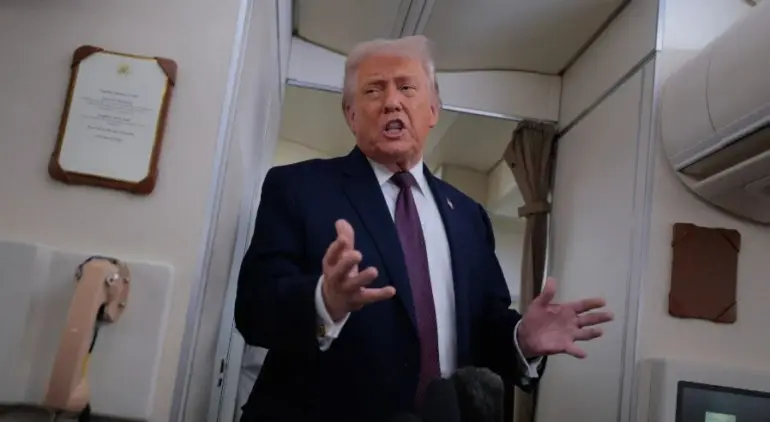
South Korea’s government held emergency talks on Tuesday following remarks by US President Donald Trump that he would raise tariffs on South Korean goods, including automobiles, lumber and pharmaceuticals.
Trump said on Monday that the tariffs would be increased, accusing South Korea of failing to uphold the terms of a previous trade agreement with Washington. The proposed hike would raise tariff levels from 15 per cent to 25 per cent.
South Korea’s presidential office said it had not received any prior official notification of the planned tariff increase.
“South Korea’s legislature is not living up to its deal with the United States,” Trump wrote on his Truth Social platform, adding that he was raising tariffs “because the Korean legislature hasn’t enacted our historic trade agreement, which is their prerogative.”
In response, Seoul convened an emergency meeting to coordinate its position. Trade and Industry Minister Kim Jung-kwan, who is currently in Canada, joined the talks remotely.
“Our government intends to convey its commitment to implementing the tariff agreement to the US side while responding in a calm and measured manner,” the government said in a statement.
Seoul added that it believes any tariff hike would only take effect after administrative procedures, including publication in the US Federal Register.
South Korea also announced that Trade Minister Kim will travel to Washington for discussions with US Commerce Secretary Howard Lutnick.
Trump’s apparent policy shift comes months after Washington and Seoul reached a trade and security agreement following a period of tense negotiations. The deal was finalised after Trump met South Korean President Lee Jae Myung in October and included South Korean investment commitments in exchange for US tariff reductions.
However, the agreement has remained in legal limbo in South Korea. The presidential office said in November that parliamentary approval was not required, arguing the deal constituted a memorandum of understanding rather than a binding treaty.
Asked on Tuesday whether the agreement had been submitted to parliament, a senior official told AFP the matter was still under review.
Under the agreement, US tariffs on South Korean goods including vehicles, auto parts and pharmaceuticals were capped at 15 per cent, down from a previous rate of 25 per cent on automobiles. Trump’s latest threat, if implemented, would reverse those reductions.
Export impact
The auto sector accounts for about 27 per cent of South Korea’s exports to the United States, which absorbs nearly half of the country’s total vehicle exports.
A return to higher tariffs could also place South Korean products at a disadvantage compared with competitors such as Japan and the European Union, both of which have secured US tariff rates of 15 per cent.
The Trump administration has yet to issue formal notices to enact the proposed changes.
The threat against South Korea is the latest in a series of warnings directed at key US trading partners. Over the weekend, Trump cautioned Canada that it would face a 100 per cent tariff if it reached a trade agreement with China.
Earlier in January, he also threatened tariffs against several European countries over his demand to purchase Greenland, a threat he has since withdrawn.
AFP