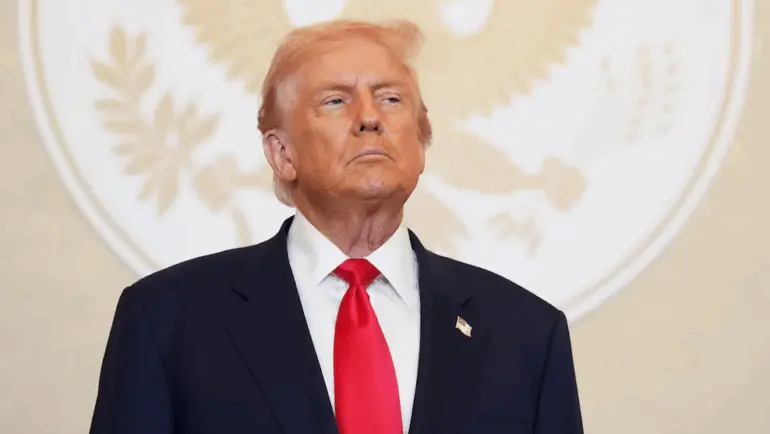
President Donald Trump’s decision to withdraw the United States from a major climate treaty drew sharp criticism from the European Union on Thursday, with EU officials vowing to continue tackling climate change alongside other nations.
The White House on Wednesday announced that the US would exit 66 international organizations and treaties, roughly half of them affiliated with the United Nations, citing them as “contrary to the interests of the United States.”
Among the most notable is the United Nations Framework Convention on Climate Change (UNFCCC), the foundational treaty for all major international climate agreements. Adopted in 1992, the treaty establishes a framework for nations to reduce greenhouse gas emissions and adapt to the impacts of climate change.
EU climate chief Wopke Hoekstra described the treaty as a cornerstone of global climate action. “The decision by the world’s largest economy and second-largest emitter to retreat from it is regrettable and unfortunate,” he said in a LinkedIn post. “We will continue to support international climate research and cooperation.”
Trump’s climate stance
Trump, who has prioritized fossil fuels in his domestic policy, has repeatedly dismissed climate science, calling human-driven climate change a “hoax.” His administration did not send a delegation to the UN climate summit in Brazil in November, an annual event under the UNFCCC.
Teresa Ribera, the EU’s vice president for the clean transition, criticized the administration, saying it “doesn’t care” about the environment, public health, or the suffering of people.
Legal and global implications
The UNFCCC was adopted at the 1992 Rio Earth Summit and ratified by the U.S. Senate during President George H.W. Bush’s administration. Climate expert Li Shuo of the Asia Society Policy Institute told AFP that the U.S. withdrawal is “a heavy blow to global climate action,” threatening decades of consensus.
The US Constitution allows presidents to enter treaties with a two-thirds Senate vote but does not specify the withdrawal process, creating potential legal challenges. Jean Su, a senior attorney at the Center for Biological Diversity, said, “Pulling out of the UNFCCC is a whole order of magnitude different from pulling out of the Paris Agreement. We contend it is illegal for the President to unilaterally exit a treaty ratified by the Senate, and we are exploring legal options.”
Trump has previously withdrawn the U.S. from the Paris Agreement, a move later reversed by President Joe Biden. Exiting the UNFCCC could complicate any future efforts to rejoin global climate accords.
Political backlash
California Governor Gavin Newsom, a vocal Trump critic, said in a statement, “Our president is surrendering America’s leadership on the world stage and weakening our ability to compete in the economy of the future, creating a leadership vacuum that China is already exploiting.”
The White House memo also orders withdrawal from the Intergovernmental Panel on Climate Change (IPCC), the International Renewable Energy Agency, UN Oceans, and UN Water. As in his first term, Trump has also exited UNESCO, the World Health Organization, and sharply reduced foreign aid. Other affected bodies include UNFPA, UN Women, and UNCTAD.
Rubio cites ‘progressive ideology’
Secretary of State Marco Rubio said the withdrawals reflect a fight against “progressive ideology” in international institutions, which he accused of seeking to “constrain American sovereignty.”
“From DEI (Diversity, Equity, and Inclusion) mandates to gender equity campaigns to climate orthodoxy, many international organizations now serve a globalist project,” Rubio said, framing the exits as part of a broader ideological reset.
AFP