
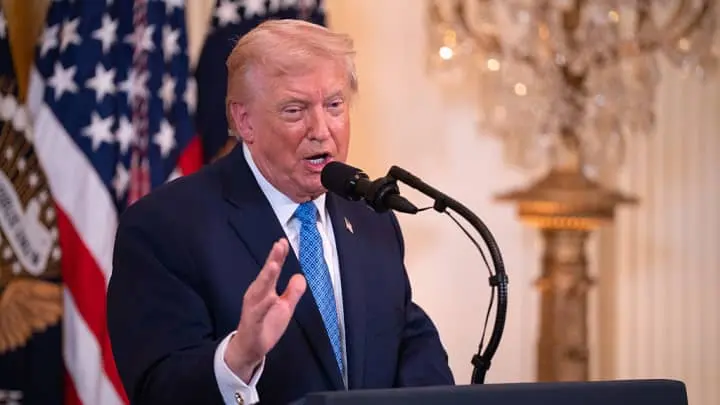
US President Donald Trump has ordered the United States to withdraw from 66 international organisations, marking one of the most sweeping rollbacks of American participation in multilateral institutions in modern history.
In a statement issued Wednesday, Secretary of State Marco Rubio said the move was carried out under Executive Order 14199 following an administration-wide review of international organisations receiving US funding or participation.
Rubio said the review found that many of the organisations were “redundant, mismanaged, unnecessary, or actively working against US interests,” while others had become vehicles for ideological agendas that undermine national sovereignty.
“It is no longer acceptable to be sending these institutions the blood, sweat, and treasure of the American people with little to nothing to show for it,” Rubio said.
According to the State Department, billions of dollars in US taxpayer funds have flowed for years to international bodies that deliver minimal results while advancing policies at odds with the Trump administration’s priorities. Rubio said the administration was determined to end that practice.
Trump has directed all executive departments and agencies to take immediate steps to effect the withdrawals as quickly as possible.
UN and non-UN bodies affected
Of the 66 organisations identified, 31 are United Nations entities, while 35 are non-UN affiliated.
Notable among those affected are the United Nations Population Fund (UNFPA) and the United Nations Framework Convention on Climate Change (UNFCCC), which the White House says operate contrary to US national interests.
Since returning to office in January, Trump has already initiated the withdrawal of the United States from the World Health Organization (WHO) and the Paris Climate Agreement. He later signed executive orders pulling the US out of the UN Human Rights Council (UNHRC) and banning future funding for the UN Relief and Works Agency for the Near East (UNRWA).
The memo also directs US withdrawal from the Intergovernmental Panel on Climate Change (IPCC), the International Renewable Energy Agency, UN Oceans, and UN Water. As during his first term, Trump has also withdrawn the US from UNESCO and sharply reduced foreign aid.
Climate treaties and global reaction
The decision to exit the UNFCCC has drawn sharp criticism from the European Union. EU climate chief Wopke Hoekstra described the move as “regrettable and unfortunate,” noting that the treaty underpins global climate cooperation.
“The decision by the world’s largest economy and second-largest emitter to retreat from it is deeply concerning,” Hoekstra said, adding that the EU would continue to support international climate research and cooperation.
Teresa Ribera, the EU’s vice-president for the clean transition, said the Trump administration “doesn’t care” about environmental protection or public health.
Adopted at the 1992 Rio Earth Summit and approved by the US Senate under President George H.W. Bush, the UNFCCC forms the legal foundation for global climate action, including annual COP meetings and agreements such as the Paris Accord.
Climate experts warn the withdrawal could face legal challenges. While the US Constitution outlines how treaties are ratified, it is silent on the process for withdrawal.
Jean Su, a senior attorney at the Center for Biological Diversity, said pulling out of the UNFCCC is “a whole order of magnitude different” from leaving the Paris Agreement and may be unconstitutional without Senate approval.
Political and legal fallout
California Governor Gavin Newsom, a prominent Trump critic, said the move “surrenders America’s leadership on the world stage” and creates a vacuum that rivals such as China are already exploiting.
Climate analyst Li Shuo of the Asia Society Policy Institute described the withdrawal as a “heavy blow to global climate action,” warning it could fracture decades of international consensus.
Trump, who has long dismissed climate change as a “hoax,” has thrown his administration’s support behind fossil fuels and sent no US delegation to the most recent UN climate summit in Brazil.
Ideology and ‘America first’
Rubio framed the withdrawals as part of a broader rejection of what he described as “progressive ideology” embedded within international institutions.
“From DEI mandates to gender equity campaigns to climate orthodoxy, many international organisations now serve a globalist project that constrains American sovereignty,” he said.
He criticised what he called a “sprawling architecture of global governance” driven by elite NGO networks, arguing that institutions once designed for practical cooperation have drifted away from the interests of sovereign nations.
While stressing that the US is not abandoning diplomacy entirely, Rubio said future engagement would be selective and based strictly on tangible benefits to Americans.
“We will not continue expending resources, diplomatic capital, and the legitimising weight of our participation in institutions that are irrelevant to or in conflict with our interests,” he said.
What comes next
Federal agencies have been instructed to implement the withdrawals, while the State Department continues reviewing additional organisations under Executive Order 14199. Further exits may be announced in the coming months.
The move represents a significant escalation of the Trump administration’s America-first foreign policy and a fundamental reshaping of US engagement with the global multilateral system.
