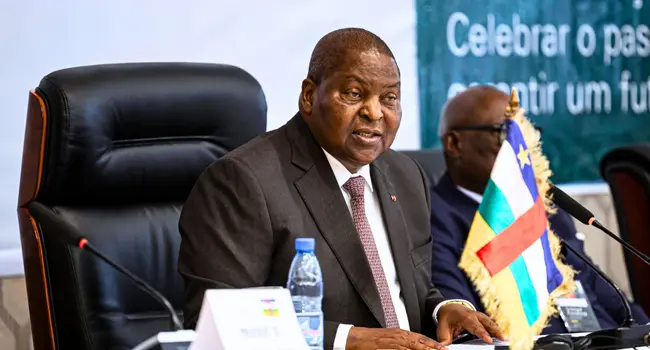
President Faustin-Archange Touadera has been re-elected in the Central African Republic, according to provisional results released by the country’s electoral authority on Tuesday.
Touadera, 68, secured more than 76 per cent of the vote in the December 28 presidential election, the National Authority of Elections announced. His closest challenger, former prime minister Anicet-Georges Dologuele, finished second with 15 per cent, while Henri-Marie Dondra placed third with three per cent.
Voter turnout stood at about 52 per cent in polls that also included legislative, municipal and local elections. Final results are expected to be announced in mid-January, following the consideration of any legal challenges.
The president had been widely tipped to secure a third term after a new constitution adopted in 2023 removed term limits. He ran in a seven-candidate race, presenting himself as a guarantor of stability in a country long plagued by conflict and political instability.
Sections of the opposition boycotted the vote, denouncing it as neither credible nor inclusive and accusing the government of refusing meaningful political dialogue.
Dologuele claimed victory shortly after the polls closed, alleging widespread irregularities. His claims were dismissed by Touadera’s camp as “false”, with a warning that such statements risked provoking unrest. Dondra also called for the annulment of the election results.
Despite the controversy, observers from the African Union said the elections were conducted peacefully.
‘Stability candidate’
Touadera has governed since 2016, a period during which violence has eased in parts of the impoverished country, though clashes between armed groups and government forces continue in some regions.
During the campaign, he highlighted improvements in security, infrastructure development, including road construction, public lighting in the capital, and flood-control projects. He also pointed to social policies such as free healthcare for women and young children and increased investment in education.
Critics, however, have labelled him “President Wagner”, citing his close ties with Moscow and reliance on Russian paramilitary forces to bolster national security.
In 2019, Touadera signed a controversial peace agreement with 14 armed groups, integrating former warlords into government in exchange for the disarmament of their militias.
Opposition candidates complained of restrictions on campaigning, alleging they were prevented from travelling to provincial areas to hold rallies and were limited to small-scale events in neighbourhoods, schools, and party offices. They also faced potential disqualification over allegations of holding dual citizenship.
Despite claims of progress, the Central African Republic remains one of the world’s poorest countries. About 71 per cent of the population lives below the poverty line, grappling with inadequate basic services, poor infrastructure, high unemployment, low educational attainment, and a rising cost of living.