
Deposed Venezuelan president Nicolas Maduro appeared before a federal court in New York on Monday, days after his dramatic capture in Caracas during a US military operation that has reshaped Venezuela’s political landscape and intensified global tensions.
Maduro, 63, is facing US narcotrafficking charges alongside his wife, Cilia Flores. Both were seized early Saturday in a coordinated operation involving US commandos, helicopters, fighter jets and naval support, before being flown out of Venezuela.
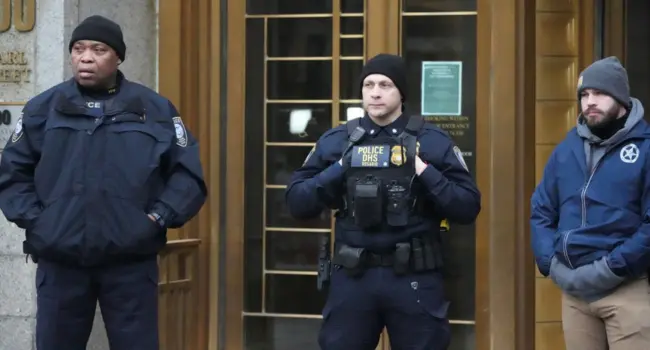
On Monday morning, Maduro was escorted under heavy security to the courthouse after being transported by helicopter and armoured vehicle. His appearance comes as Washington signals plans to assert control over key aspects of the oil-rich nation’s future.
Attention has now turned to developments inside Venezuela. Late Sunday, interim leader Delcy Rodríguez softened her initial defiant stance, offering cooperation with the United States.
“We extend an invitation to the US government to work together on an agenda for cooperation,” Rodríguez said, marking a notable shift in tone.
Earlier on Sunday, around 2,000 Maduro supporters rallied in Caracas, including armed motorcyclists, waving Venezuelan flags and chanting slogans. The Venezuelan military, which has remained loyal to Maduro, announced it recognised Rodríguez as interim leader and urged calm.
No official death toll has been released, but Defence Minister Vladimir Padrino López said a “large part” of Maduro’s security detail, as well as military personnel and civilians, were killed during the operation.
US President Donald Trump declared late Sunday that the United States was now “in charge” of Venezuela, while Secretary of State Marco Rubio said discussions about elections were “premature”.
‘Need access to oil’
Asked what Washington expects from Rodríguez, Trump said: “We need total access. We need access to the oil and other things in their country that allow us to rebuild their country.”
Venezuela holds the world’s largest proven oil reserves, and analysts say any increase in supply could affect global oil markets. However, experts caution that reviving Venezuela’s oil output would be costly, complex and slow, given years of underinvestment and sanctions.
Oil prices dipped slightly as investors assessed the unfolding situation.
The Trump administration has maintained an oil blockade on Venezuela and warned that further military action remains an option. While no US troops are believed to be operating inside the country, a substantial US naval presence, including an aircraft carrier, remains stationed offshore.
Leading opposition figure Edmundo González Urrutia said the US intervention was “important” but insufficient without the release of political prisoners and recognition of his claim to victory in the disputed 2024 election.
Details of the operation continued to emerge on Monday. Cuba said 32 of its nationals were killed in the attack, while Trump suggested that Havana itself could be the next to face pressure.
“I don’t think we need any action. It looks like it’s going down,” Trump said.
The UN Security Council is scheduled to hold an emergency meeting on Monday at Venezuela’s request.
Maduro allies remain
The White House has indicated it is not seeking wholesale regime change, but rather Maduro’s removal and the installation of a cooperative government, even if led by figures previously close to him.
Maduro, who was handpicked by the late Hugo Chávez before his death in 2013, governed alongside a small inner circle that included Rodríguez, her brother Jorge Rodríguez, and Interior Minister Diosdado Cabello.
“It’s like a club of five,” a diplomatic source in Caracas told AFP.
The US stance has left Venezuela’s opposition marginalised, despite Washington’s claims that Maduro stole the last election.
China, Russia and Iran — all longtime allies of Maduro — swiftly condemned the operation. China called for his “immediate release,” describing the raid as a “clear violation of international law,” while Iran said its relations with Venezuela remained unchanged.
Several US allies, including members of the European Union, expressed alarm.
Colombian President Gustavo Petro condemned the operation as an “assault on Latin American sovereignty” that could spark a humanitarian crisis. He also rejected Trump’s threats of military action against Colombia and denied US allegations linking him to drug trafficking.
