
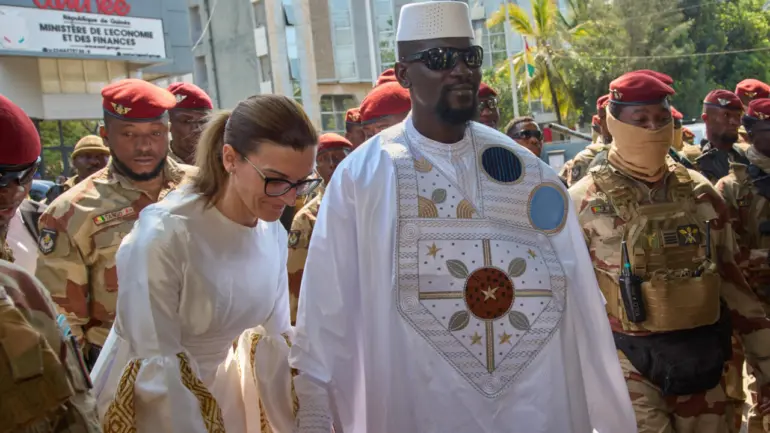
Guinea’s junta leader, Mamady Doumbouya, who pledged not to seek elective office after seizing power four years ago, has been elected president with an overwhelming majority, according to provisional results released Tuesday by the country’s election authority.
Doumbouya, 41, contested the presidency against eight other candidates in the weekend vote. However, leading opposition figures were barred from running and had called for a boycott of the election.
In a reversal of his earlier commitment to return the mineral-rich but impoverished West African nation to civilian rule by the end of 2024, the former general entered the race and secured 86.72 per cent of the first-round vote, according to the General Directorate of Elections—well above the threshold required to avoid a runoff.
Voter turnout was put at 80.95 per cent, election chief Djenabou Toure said.
Official partial results showed Doumbouya dominating polling districts across the capital, Conakry, where he often recorded more than 80 per cent of the vote. He posted similarly strong performances in several other areas, including Coyah near the capital, Boffa and Fria in the west, Gaoual in the northwest, Koundara and Labe in the north, and Nzerekore in the southeast.
However, the credibility of the vote has been challenged by civil society and opposition groups. The National Front for the Defence of the Constitution, a citizens’ movement advocating a return to civilian rule, said a large number of Guineans boycotted what it described as an “electoral charade.”
“A huge majority of Guineans chose to boycott the electoral charade,” the group said in a statement on Monday.
Some candidates also alleged irregularities. Abdoulaye Yero Balde cited “serious irregularities,” including the exclusion of his representatives from vote-counting centres and alleged ballot stuffing in some areas. Another candidate, Faya Millimono, accused authorities of “electoral banditry,” claiming voters were improperly influenced.
Doumbouya came to power in September 2021 after leading a coup that ousted Guinea’s first democratically elected president, Alpha Conde. Since then, his administration has faced criticism for curbing civil liberties, banning protests, and arresting or forcing political opponents into exile.
In late September, Guineans approved a new constitution in a referendum that allowed junta members to run for office, clearing the path for Doumbouya’s candidacy. The new charter also extended presidential terms from five to seven years, renewable once.
Prominent opposition leader and former prime minister Cellou Dalein Diallo was among those barred from contesting the election under the new constitution because he lives in exile and does not maintain a primary residence in Guinea.
Former president Alpha Conde and another ex-prime minister, Sidya Toure—both also in exile—were similarly excluded for exceeding the constitutional age limit of 80.
AFP
