The Chairman of the Presidential Committee on Fiscal Policy and Tax Reforms, Taiwo Oyedele, has insisted that the January 1, 2026 implementation date for Nigeria’s new tax laws remains unchanged.
Oyedele spoke on Friday in Lagos while briefing journalists after a meeting with President Bola Tinubu. The meeting was also attended by the Chairman of the Federal Inland Revenue Service (FIRS), Zacchaeus Adedeji, and the Chairman of the National Tax Policy Implementation Committee, Joseph Tegbe.
According to Oyedele, the Nigerian Tax Act and the Nigerian Tax Administration Act will take effect as scheduled because the reforms are aimed at easing the financial burden on Nigerians.
“The plan to commence the new laws on January 1, 2026, will go ahead as scheduled because these reforms are designed to provide relief to the Nigerian people,” he said.
He explained that under the new regime, about 98 per cent of workers would either pay no Pay As You Earn (PAYE) tax or face reduced tax obligations. He added that approximately 97 per cent of small businesses would be exempt from Corporate Income Tax, Value Added Tax (VAT), and Withholding Tax, while larger companies would also benefit from lower tax rates.
“The whole idea is to promote economic growth, inclusivity, and shared prosperity for our people,” Oyedele said.
He welcomed the National Assembly’s decision to review allegations of alterations to the tax laws, noting that the Federal Government is ready to work with lawmakers to address concerns raised by Nigerians, including opposition figures.
The new tax laws have, however, been mired in controversy. A member of the House of Representatives, Abdussamad Dasuki, recently alleged discrepancies between the versions of the tax bills passed by the National Assembly and those later gazetted and released to the public.
Dasuki argued that his legislative rights had been violated, claiming the gazetted versions did not reflect what lawmakers debated and approved.
“Before you can say there is a difference between what was gazetted and what was passed, we don’t have what was passed,” he said.
“The official harmonised bills certified by the Clerk of the National Assembly, which were sent to the President, are not available for comparison. Only lawmakers can say authoritatively what was transmitted.

“It should be the harmonised version certified by the Clerk. Even I cannot say I have it. I only have what was presented to the President for assent,” he added.
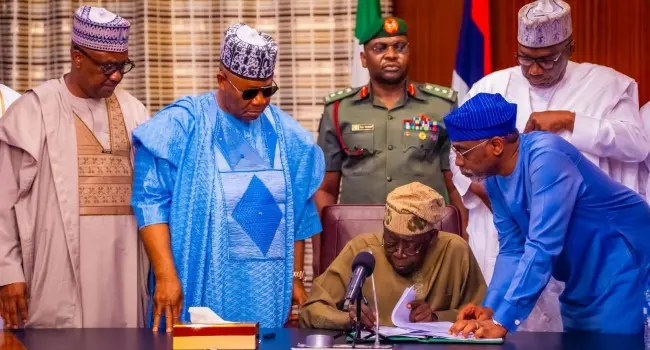
President Tinubu signed the four tax reform bills into law, describing them as the most significant overhaul of Nigeria’s tax system in decades.
Despite earlier opposition from some federal lawmakers, particularly from the northern part of the country, the laws are scheduled to take effect on January 1, 2026.
The legislation includes the Nigeria Tax Act, the Nigeria Tax Administration Act, the Nigeria Revenue Service (Establishment) Act, and the Joint Revenue Board (Establishment) Act. Under the reforms, the laws will operate under a single authority, the Nigeria Revenue Service.