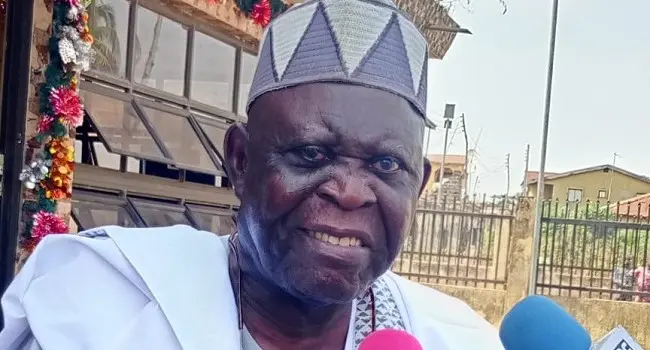
Former Secretary-General of the pan-Yoruba socio-political organisation Afenifere and NADECO chieftain, Ayo Opadokun, has described the worsening insecurity across parts of Nigeria as a deliberate and well-coordinated effort by destructive forces, rather than a series of isolated incidents.
Speaking on the sidelines of his installation as Grand Patron of the Christian Association of Nigeria (CAN), Offa Local Government Area chapter, in Kwara State on Sunday, Opadokun said bandits and insurgents were being actively sponsored by various interests seeking to destabilise the country.
“Some Nigerians, including agents who want to destabilise Nigeria and those who do not want this government, took far-reaching decisions long ago about the future of this country,” he said.
The elder statesman, who described the nation’s security situation as deeply troubling, said successive warnings to the Federal Government about the growing threat of non-state actors wielding weapons more sophisticated than those of the conventional armed forces were ignored.
“But they never listened,” he said.
Opadokun further claimed that the current crisis was the result of long-term planning, citing a meeting he said he attended in August 2022 at the Nicon Hilton Hotel, Abuja.
“I can say this without fear of contradiction. There was a four-day meeting involving some Nigerians and elements from the Sahel region, where plans were laid to overrun Nigeria. We are now seeing the consequences. As former Kaduna State governor Nasir El-Rufai also alluded to, what is happening today is not accidental; it is planned,” he said.
He urged the Federal Government not to relent in its fight against insurgency, insisting that there should be no leniency for bandits or their sponsors.
On the economy, Opadokun commended President Bola Tinubu for what he described as bold and far-reaching policy decisions, particularly in the area of fiscal reforms.
“The new tax reforms are effectively taking a shot at fiscal federalism,” he said, adding that from January next year, many low-income Nigerians would no longer be required to pay tax because their earnings were insufficient to meet basic welfare needs.
He noted that the reforms would significantly affect institutions such as banks, which he accused of exploiting Nigerians. “People should appreciate what President Tinubu has achieved so far, though he has not yet reached the destination we desire,” he said.
Speaking from the standpoint of NADECO, Opadokun reiterated the group’s long-standing demand for a return to constitutional governance.
“Our goal is for Nigeria to operate under a truly home-grown constitution. The current unitarised federal structure was imposed by military rulers, and Nigeria has yet to produce its own people-driven constitution,” he said.
Reflecting on the state of the nation, Opadokun said Nigeria stood at a critical juncture as of December 2025, with the Tinubu administration pursuing difficult but necessary structural reforms to address entrenched systemic weaknesses.
While acknowledging positive macroeconomic indicators, he warned that such gains would remain “elitist exercises” unless they translated into tangible improvements in the living conditions of ordinary Nigerians.

He expressed confidence that President Tinubu would use the remainder of his first term to ensure that economic reforms yield real benefits for households, citing recent directives to state governors as evidence of the President’s resolve.
However, Opadokun cautioned that the social costs of the reforms had been severe, with inflation, rising living costs, shrinking purchasing power, and pressure on small businesses deepening public hardship.
“Any honest assessment must acknowledge that the burden of reform has fallen disproportionately on ordinary citizens,” he said.
He added that while the administration had shown decisiveness and political confidence, effective leadership in times of sacrifice must also be defined by empathy, transparent communication, and deliberate efforts to carry citizens along.
On security and national cohesion, Opadokun said many communities continued to live in fear despite government efforts, stressing that lasting stability required justice, inclusion, fairness, and sustained dialogue among Nigeria’s diverse peoples.
He concluded that the Tinubu administration should not be judged solely on the boldness of its reforms, but on how effectively they restore dignity, opportunity, and hope to the average Nigerian.
“As an elder statesman, I call for restraint in public discourse, patience where necessary, and accountability at all levels. Constructive criticism, national unity, and a shared commitment to the common good are essential if Nigeria is to emerge stronger from this defining period,” he said.